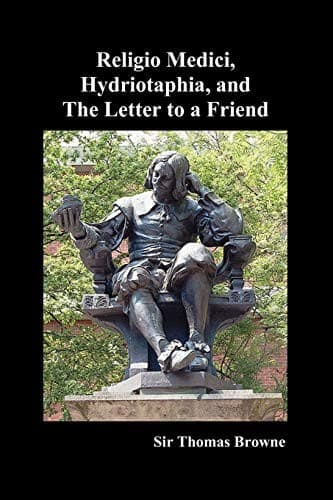
Religio Medici, Hydriotaphia, and the Letter to a FriendBrowne, Thomas, Sir
Religion
Religio Medici, Hydriotaphia, and the Letter to a Friend
Browne, Thomas, Sir
Christian ethics; Christian life; Essays; Funeral rites and ceremonies; Medical ethics; Medicine -- History; Religion and medicine
_Sect._ 20.--Neither had these or any other ever such advantage of me,
as to incline me to any point of infidelity or desperate positions of
atheism; for I have been these many years of opinion there was never
any. Those that held religion was the difference of man from beasts,
have spoken probably, and proceed upon a principle as inductive as
the other. That doctrine of Epicurus, that denied the providence of
God, was no atheism, but a magnificent and high-strained conceit of
his majesty, which he deemed too sublime to mind the trivial actions
of those inferior creatures. That fatal necessity of the stoicks is
nothing but the immutable law of his will. Those that heretofore denied
the divinity of the Holy Ghost have been condemned but as hereticks;
and those that now deny our Saviour, though more than hereticks, are
not so much as atheists: for, though they deny two persons in the
Trinity, they hold, as we do, there is but one God.
That villain and secretary of hell,[26] that composed that miscreant
piece of the three impostors, though divided from all religions, and
neither Jew, Turk, nor Christian, was not a positive atheist. I confess
every country hath its Machiavel, every age its Lucian, whereof common
heads must not hear, nor more advanced judgments too rashly venture on.
It is the rhetorick of Satan; and may pervert a loose or prejudicate
belief.
_Sect._ 21.--I confess I have perused them all, and can discover
nothing that may startle a discreet belief; yet are their heads carried
off with the wind and breath of such motives. I remember a doctor in
physick, of Italy, who could not perfectly believe the immortality of
the soul, because Galen seemed to make a doubt thereof. With another I
was familiarly acquainted, in France, a divine, and a man of singular
parts, that on the same point was so plunged and gravelled with three
lines of Seneca,[E] that all our antidotes, drawn from both Scripture
and philosophy, could not expel the poison of his error. There are a
set of heads that can credit the relations of mariners, yet question
the testimonies of Saint Paul: and peremptorily maintain the traditions
of Ælian or Pliny; yet, in histories of Scripture, raise queries and
objections: believing no more than they can parallel in human authors.
I confess there are, in Scripture, stories that do exceed the fables of
poets, and, to a captious reader, sound like Garagantua or Bevis.[27]
Search all the legends of times past, and the fabulous conceits of
these present, and ’twill be hard to find one that deserves to carry
the buckler unto Samson; yet is all this of an easy possibility,
if we conceive a divine concourse, or an influence from the little
finger of the Almighty. It is impossible that, either in the discourse
of man or in the infallible voice of God, to the weakness of our
apprehensions there should not appear irregularities, contradictions,
and antinomies:[28] myself could show a catalogue of doubts, never yet
Public-domain text, read in full here on John Shaqi.
Reviews
Reviews
No reviews yet
Be the first to share your thoughts on this work.
Join the Discussion
Join the discussion
Sign in to leave a comment or review.
Sign InorCreate an account