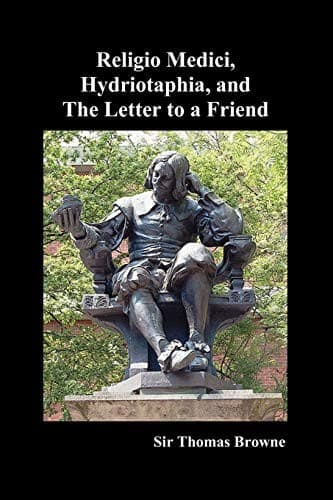
Religio Medici, Hydriotaphia, and the Letter to a FriendBrowne, Thomas, Sir
Religion
Religio Medici, Hydriotaphia, and the Letter to a Friend
Browne, Thomas, Sir
Christian ethics; Christian life; Essays; Funeral rites and ceremonies; Medical ethics; Medicine -- History; Religion and medicine
imagined nor questioned, as I know, which are not resolved at the first
hearing; not fantastick queries or objections of air; for I cannot
hear of atoms in divinity. I can read the history of the pigeon that
was sent out of the ark, and returned no more, yet not question how
she found out her mate that was left behind: that Lazarus was raised
from the dead, yet not demand where, in the interim, his soul awaited;
or raise a law-case, whether his heir might lawfully detain his
inheritance bequeathed upon him by his death, and he, though restored
to life, have no plea or title unto his former possessions. Whether
Eve was framed out of the left side of Adam, I dispute not; because
I stand not yet assured which is the right side of a man; or whether
there be any such distinction in nature. That she was edified out of
the rib of Adam, I believe; yet raise no question who shall arise with
that rib at the resurrection. Whether Adam was an hermaphrodite, as the
rabbins contend upon the letter of the text; because it is contrary
to reason, there should be an hermaphrodite before there was a woman,
or a composition of two natures, before there was a second composed.
Likewise, whether the world was created in autumn, summer, or the
spring; because it was created in them all: for, whatsoever sign the
sun possesseth, those four seasons are actually existent. It is the
nature of this luminary to distinguish the several seasons of the year;
all which it makes at one time in the whole earth, and successively
in any part thereof. There are a bundle of curiosities, not only in
philosophy, but in divinity, proposed and discussed by men of most
supposed abilities, which indeed are not worthy our vacant hours, much
less our serious studies. Pieces only fit to be placed in Pantagruel’s
library, or bound up with Tartaratus, _De Modo Cacandi_.[F][29]
[E] “Post mortem nihil est, ipsaque mors nihil, mors individua est
noxia corpori, nec patiens animæ. . . . Toti morimur nullaque pars
manet nostri.”
[F] In Rabelais.
_Sect._ 22.--These are niceties that become not those that peruse so
serious a mystery. There are others more generally questioned, and
called to the bar, yet, methinks, of an easy and possible truth.
Public-domain text, read in full here on John Shaqi.
Reviews
Reviews
No reviews yet
Be the first to share your thoughts on this work.
Join the Discussion
Join the discussion
Sign in to leave a comment or review.
Sign InorCreate an account