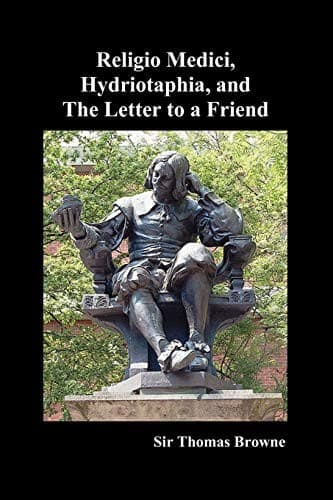
Religio Medici, Hydriotaphia, and the Letter to a FriendBrowne, Thomas, Sir
Religion
Religio Medici, Hydriotaphia, and the Letter to a Friend
Browne, Thomas, Sir
Christian ethics; Christian life; Essays; Funeral rites and ceremonies; Medical ethics; Medicine -- History; Religion and medicine
’Tis ridiculous to put off or down the general flood of Noah, in that
particular inundation of Deucalion.[30] That there was a deluge once
seems not to me so great a miracle as that there is not one always. How
all the kinds of creatures, not only in their own bulks, but with a
competency of food and sustenance, might be preserved in one ark, and
within the extent of three hundred cubits, to a reason that rightly
examines it, will appear very feasible. There is another secret, not
contained in the Scripture, which is more hard to comprehend, and put
the honest Father[31] to the refuge of a miracle; and that is, not only
how the distinct pieces of the world, and divided islands, should be
first planted by men, but inhabited by tigers, panthers, and bears.
How America abounded with beasts of prey, and noxious animals, yet
contained not in it that necessary creature, a horse, is very strange.
By what passage those, not only birds, but dangerous and unwelcome
beasts, come over. How there be creatures there (which are not found in
this triple continent). All which must needs be strange unto us, that
hold but one ark; and that the creatures began their progress from the
mountains of Ararat. They who, to salve this, would make the deluge
particular, proceed upon a principle that I can no way grant; not only
upon the negative of Holy Scriptures, but of mine own reason, whereby
I can make it probable that the world was as well peopled in the time
of Noah as in ours; and fifteen hundred years, to people the world,
as full a time for them as four thousand years since have been to us.
There are other assertions and common tenets drawn from Scripture,
and generally believed as Scripture, whereunto, notwithstanding, I
would never betray the liberty of my reason. ’Tis a paradox to me,
that Methusalem was the longest lived of all the children of Adam;
and no man will be able to prove it; when, from the process of the
text, I can manifest it may be otherwise. That Judas perished by
hanging himself, there is no certainty in Scripture: though, in one
place, it seems to affirm it, and, by a doubtful word, hath given
occasion to translate[32] it; yet, in another place, in a more
punctual description, it makes it improbable, and seems to overthrow
it. That our fathers, after the flood, erected the tower of Babel, to
preserve themselves against a second deluge, is generally opinioned
and believed; yet is there another intention of theirs expressed in
Scripture. Besides, it is improbable, from the circumstance of the
place; that is, a plain in the land of Shinar. These are no points of
faith; and therefore may admit a free dispute. There are yet others,
and those familiarly concluded from the text, wherein (under favour) I
see no consequence. The church of Rome confidently proves the opinion
of tutelary angels, from that answer, when Peter knocked at the door,
“’Tis not he, but his angel;” that is, might some say, his messenger,
Public-domain text, read in full here on John Shaqi.
Reviews
Reviews
No reviews yet
Be the first to share your thoughts on this work.
Join the Discussion
Join the discussion
Sign in to leave a comment or review.
Sign InorCreate an account