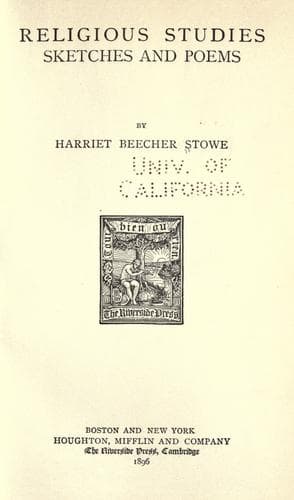
Religious Studies, Sketches and Poems — John Shaqi
Religious Studies, Sketches and PoemsStowe, Harriet Beecher
Religion
Religious Studies, Sketches and Poems
Stowe, Harriet Beecher
Religion
There has been in this world one rare flower of Paradise,--a holy
childhood growing up gradually into a holy manhood, and always
retaining in mature life the precious, unstained memories of perfect
innocence. The family at Nazareth was evidently a secluded one.
Persons of such an elevated style of thought as Joseph and Mary,
conscious of so solemn a destiny and guarding with awe the treasure
and hope of a world, must have been so altogether different from the
ordinary peasants of Nazareth that there could have been little more
than an external acquaintance between them. They were undoubtedly
loving, gentle, and tender to every one, full of sympathy for
trouble and of kind offices in sickness, but they carried within
their hearts a treasury of thoughts, emotions, and hopes, which
could not be perceived by those whose spiritual eyes had never been
opened. It is quite evident from the surprise that the Nazarenes
manifested when Christ delivered his first sermon among them that
they had never seen anything unusual in the family, and that Christ
himself had been living among them only as the carpenter's son.
This case is not peculiar. The great artist or poet often grows to
manhood without one of his townspeople suspecting who he is, and
what world he lives in. Milton or Raphael might so have grown up
unknown in a town of obscure fishermen.
The apocryphal gospels have busied themselves in inventing legends
of this child-life of Jesus. Nothing so much shows the difference
between the false and the true as these apocryphal gospels compared
with the real. Jesus is represented there as a miraculous child,
using supernatural power for display among his schoolmates and for
the gratification of childish piques and resentments.
The true gospel gives but one incident of the child-life of Jesus,
and that just at the time when childhood is verging into youth; for
the rest, we are left to conjecture.
We are told that his infancy was passed in the land of Egypt.
Jesus was the flower of his nation,--he was the blossom of its
history,--and therefore it seemed befitting that his cradle should
be where was the cradle of his great forerunner, Moses, on the
banks of the Nile. The shadows of the Pyramids, built by the labors
of his ancestors, were across the land of his childhood, and the
great story of their oppression and deliverance must have filled
the thoughts and words of his parents. So imbued was the Jewish
mind with the habit of seeing in everything in their history the
prophecy and type of the great Fulfiller, that St. Matthew speaks
of this exile in Egypt as having occurred that the type might
find completeness, and that Israel, in the person of its Head and
Representative, might a second time be called out of Egypt:--
"That it might be fulfilled that was spoken of the Lord by the
prophet,
"Out of Egypt have I called my son."
Public-domain text, read in full here on John Shaqi.
Reviews
Reviews
No reviews yet
Be the first to share your thoughts on this work.
Join the Discussion
Join the discussion
Sign in to leave a comment or review.
Sign InorCreate an account