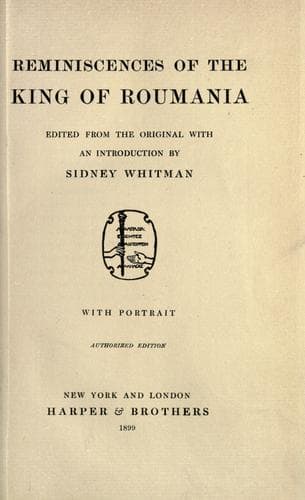
Reminiscences of the King of RoumaniaKremnitz, Mite
History
Reminiscences of the King of Roumania
Kremnitz, Mite
Carol I, King of Romania, 1839-1914; Eastern question (Balkan); Jews -- Romania; Romania -- History -- Charles I, 1866-1914
After the conquest of the Balkan Peninsula by the Turks, who were
intent on extending the Ottoman Empire even to the north of the
Danube, there was little left for the Roumanian Principalities
of Moldavia and Wallachia, deserted and abandoned to their fate
by the neighbouring Christian States, except to make the best
possible terms with the victorious followers of the Crescent. Each
Principality, therefore, concluded separate conventions with the
Sublime Porte, by means of which they aimed at domestic independence
in return for the payment of tribute and military service. These
conventions or capitulations were not infrequently violated by the
Turks as well as by the Roumanian Hospodars or Princes. Though
the rulers of Bucharest and Jassy were appointed and dismissed
at the pleasure of the Grand Seignior, the very existence of the
Principalities was due solely to the provisions of the treaties
above mentioned, by virtue of which they escaped incorporation
in the Ottoman Empire; nor were the nobility of Moldavia and
Wallachia forced to follow the example of their equals in Bosnia
and Herzegovina in embracing Islam, in order to maintain their
power over the Christian population. Still the Principalities of
the Danube did not entirely escape the ruin and misery which befell
Bulgaria and Roumelia; but, since the forms and outward appearance
of administrative independence remained, it was yet possible that
the Roumanian patriot might develop his country socially and
politically without threatening the immediate interests of the
Turkish Empire south of the Danube.
Chief amongst the difficulties which beset the regeneration of
Roumania was the rule of the Phanariotes,[5] to whom the Porte
had practically handed over the territories of the Lower Danube.
The dignity of Hospodar[6] was confined to members of the great
Phanariot families, who oppressed and misruled the whole country,
whilst the Greek nobles in their train not only monopolised all
offices and dignities, but even poisoned the national spirit
by their corrupt system. Even to-day Roumania suffers from the
after-effects of Levantine misrule, which blunted the public
conscience and confused all moral conceptions.
[5] An oligarchy of Greek families in Turkey, from which a large
proportion of high stations in the Turkish administration were
filled.
[6] Hospodar: Old Slavonic term for Lord or Master applied to the
reigning Princes in Wallachia and Moldavia.
Public-domain text, read in full here on John Shaqi.
Reviews
Reviews
No reviews yet
Be the first to share your thoughts on this work.
Join the Discussion
Join the discussion
Sign in to leave a comment or review.
Sign InorCreate an account