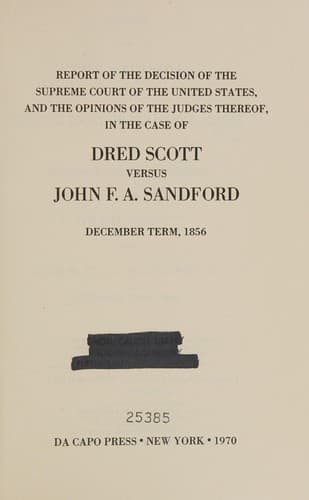
Report of the Decision of the Supreme Court of the United States, and the Opinions of the Judges Thereof, in the Case of Dred Scott versus John F. A. Sandford: December Term, 1856.United States. Supreme Court
History
Report of the Decision of the Supreme Court of the United States, and the Opinions of the Judges Thereof, in the Case of Dred Scott versus John F. A. Sandford: December Term, 1856.
United States. Supreme Court
Scott, Dred, 1809-1858; Slavery -- United States
It will be observed, that the plea applies to that class of persons
only whose ancestors were negroes of the African race, and imported
into this country, and sold and held as slaves. The only matter in
issue before the court, therefore, is, whether the descendants of such
slaves, when they shall be emancipated, or who are born of parents who
had become free before their birth, are citizens of a State, in the
sense in which the word citizen is used in the Constitution of the
United States. And this being the only matter in dispute on the
pleadings, the court must be understood as speaking in this opinion of
that class only, that is, of those persons who are the descendants of
Africans who were imported into this country, and sold as slaves.
The situation of this population was altogether unlike that of the
Indian race. The latter, it is true, formed no part of the colonial
communities, and never amalgamated with them in social connections or
in government. But although they were uncivilized, they were yet a
free and independent people, associated together in nations or tribes,
and governed by their own laws. Many of these political communities
were situated in territories to which the white race claimed the
ultimate right of dominion. But that claim was acknowledged to be
subject to the right of the Indians to occupy it as long as they
thought proper, and neither the English nor colonial Governments
claimed or exercised any dominion over the tribe or nation by whom it
was occupied, nor claimed the right to the possession of the
territory, until the tribe or nation consented to cede it. These
Indian Governments were regarded and treated as foreign Governments,
as much so as if an ocean had separated the red man from the white;
and their freedom has constantly been acknowledged, from the time of
the first emigration to the English colonies to the present day, by
the different Governments which succeeded each other. Treaties have
been negotiated with them, and their alliance sought for in war; and
the people who compose these Indian political communities have always
been treated as foreigners not living under our Government. It is true
that the course of events has brought the Indian tribes within the
limits of the United States under subjection to the white race; and it
has been found necessary, for their sake as well as our own, to regard
them as in a state of pupilage, and to legislate to a certain extent
over them and the territory they occupy. But they may, without doubt,
like the subjects of any other foreign Government, be naturalized by
the authority of Congress, and become citizens of a State, and of the
United States; and if an individual should leave his nation or tribe,
and take up his abode among the white population, he would be entitled
to all the rights and privileges which would belong to an emigrant
from any other foreign people.
We proceed to examine the case as presented by the pleadings.
Public-domain text, read in full here on John Shaqi.
Reviews
Reviews
No reviews yet
Be the first to share your thoughts on this work.
Join the Discussion
Join the discussion
Sign in to leave a comment or review.
Sign InorCreate an account