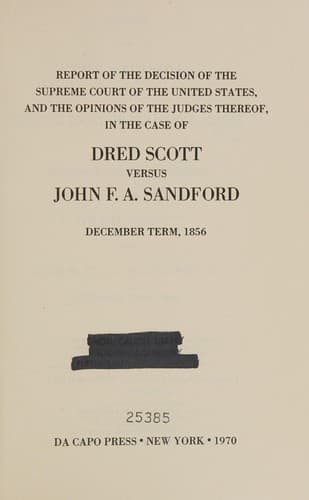
Report of the Decision of the Supreme Court of the United States, and the Opinions of the Judges Thereof, in the Case of Dred Scott versus John F. A. Sandford: December Term, 1856.United States. Supreme Court
History
Report of the Decision of the Supreme Court of the United States, and the Opinions of the Judges Thereof, in the Case of Dred Scott versus John F. A. Sandford: December Term, 1856.
United States. Supreme Court
Scott, Dred, 1809-1858; Slavery -- United States
It is very true, that in that portion of the Union where the labor of
the negro race was found to be unsuited to the climate and
unprofitable to the master, but few slaves were held at the time of
the Declaration of Independence; and when the Constitution was
adopted, it had entirely worn out in one of them, and measures had
been taken for its gradual abolition in several others. But this
change had not been produced by any change of opinion in relation to
this race; but because it was discovered, from experience, that slave
labor was unsuited to the climate and productions of these States: for
some of the States, where it had ceased or nearly ceased to exist,
were actively engaged in the slave trade, procuring cargoes on the
coast of Africa, and transporting them for sale to those parts of the
Union where their labor was found to be profitable, and suited to the
climate and productions. And this traffic was openly carried on, and
fortunes accumulated by it, without reproach from the people of the
States where they resided. And it can hardly be supposed that, in the
States where it was then countenanced in its worst form--that is, in
the seizure and transportation--the people could have regarded those
who were emancipated as entitled to equal rights with themselves.
And we may here again refer, in support of this proposition, to the
plain and unequivocal language of the laws of the several States, some
passed after the Declaration of Independence and before the
Constitution was adopted, and some since the Government went into
operation.
We need not refer, on this point, particularly to the laws of the
present slaveholding States. Their statute books are full of
provisions in relation to this class, in the same spirit with the
Maryland law which we have before quoted. They have continued to treat
them as an inferior class, and to subject them to strict police
regulations, drawing a broad line of distinction between the citizen
and the slave races, and legislating in relation to them upon the same
principle which prevailed at the time of the Declaration of
Independence. As relates to these States, it is too plain for
argument, that they have never been regarded as a part of the people
or citizens of the State, nor supposed to possess any political rights
which the dominant race might not withhold or grant at their
pleasure. And as long ago as 1822, the Court of Appeals of Kentucky
decided that free negroes and mulattoes were not citizens within the
meaning of the Constitution of the United States; and the correctness
of this decision is recognised, and the same doctrine affirmed, in 1
Meigs's Tenn. Reports, 331.
And if we turn to the legislation of the States where slavery had worn
out, or measures taken for its speedy abolition, we shall find the
same opinions and principles equally fixed and equally acted upon.
Public-domain text, read in full here on John Shaqi.
Reviews
Reviews
No reviews yet
Be the first to share your thoughts on this work.
Join the Discussion
Join the discussion
Sign in to leave a comment or review.
Sign InorCreate an account