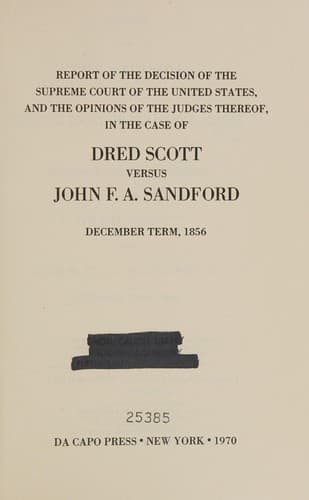
Report of the Decision of the Supreme Court of the United States, and the Opinions of the Judges Thereof, in the Case of Dred Scott versus John F. A. Sandford: December Term, 1856.United States. Supreme Court
History
Report of the Decision of the Supreme Court of the United States, and the Opinions of the Judges Thereof, in the Case of Dred Scott versus John F. A. Sandford: December Term, 1856.
United States. Supreme Court
Scott, Dred, 1809-1858; Slavery -- United States
Thus, Massachusetts, in 1786, passed a law similar to the colonial one
of which we have spoken. The law of 1786, like the law of 1705,
forbids the marriage of any white person with any negro, Indian, or
mulatto, and inflicts a penalty of fifty pounds upon any one who shall
join them in marriage; and declares all such marriages absolutely null
and void, and degrades thus the unhappy issue of the marriage by
fixing upon it the stain of bastardy. And this mark of degradation was
renewed, and again impressed upon the race, in the careful and
deliberate preparation of their revised code published in 1836. This
code forbids any person from joining in marriage any white person with
any Indian, negro, or mulatto, and subjects the party who shall offend
in this respect, to imprisonment, not exceeding six months, in the
common jail, or to hard labor, and to a fine of not less than fifty
nor more than two hundred dollars; and, like the law of 1786, it
declares the marriage to be absolutely null and void. It will be seen
that the punishment is increased by the code upon the person who shall
marry them, by adding imprisonment to a pecuniary penalty.
So, too, in Connecticut. We refer more particularly to the legislation
of this State, because it was not only among the first to put an end
to slavery within its own territory, but was the first to fix a mark
of reprobation upon the African slave trade. The law last mentioned
was passed in October, 1788, about nine months after the State had
ratified and adopted the present Constitution of the United States;
and by that law it prohibited its own citizens, under severe
penalties, from engaging in the trade, and declared all policies of
insurance on the vessel or cargo made in the State to be null and
void. But, up to the time of the adoption of the Constitution, there
is nothing in the legislation of the State indicating any change of
opinion as to the relative rights and position of the white and black
races in this country, or indicating that it meant to place the
latter, when free, upon a level with its citizens. And certainly
nothing which would have led the slaveholding States to suppose, that
Connecticut designed to claim for them, under the new Constitution,
the equal rights and privileges and rank of citizens in every other
State.
The first step taken by Connecticut upon this subject was as early as
1774, when it passed an act forbidding the further importation of
slaves into the State. But the section containing the prohibition is
introduced by the following preamble:
"And whereas the increase of slaves in this state is injurious to the
poor, and inconvenient."
Public-domain text, read in full here on John Shaqi.
Reviews
Reviews
No reviews yet
Be the first to share your thoughts on this work.
Join the Discussion
Join the discussion
Sign in to leave a comment or review.
Sign InorCreate an account