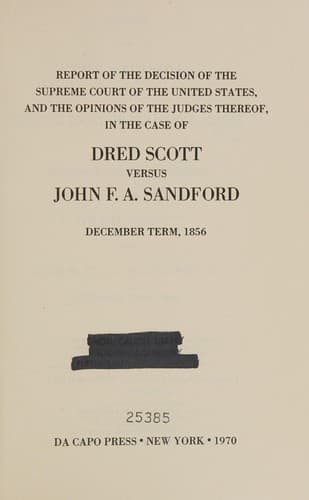
Report of the Decision of the Supreme Court of the United States, and the Opinions of the Judges Thereof, in the Case of Dred Scott versus John F. A. Sandford: December Term, 1856.United States. Supreme Court
History
Report of the Decision of the Supreme Court of the United States, and the Opinions of the Judges Thereof, in the Case of Dred Scott versus John F. A. Sandford: December Term, 1856.
United States. Supreme Court
Scott, Dred, 1809-1858; Slavery -- United States
This recital would appear to have been carefully introduced, in order
to prevent any misunderstanding of the motive which induced the
Legislature to pass the law, and places it distinctly upon the
interest and convenience of the white population--excluding the
inference that it might have been intended in any degree for the
benefit of the other.
And in the act of 1784, by which the issue of slaves, born after the
time therein mentioned, were to be free at a certain age, the section
is again introduced by a preamble assigning similar motive for the
act. It is in these words:
"Whereas sound policy requires that the abolition of slavery should be
effected as soon as may be consistent with the rights of individuals,
and the public safety and welfare"--showing that the right of property
in the master was to be protected, and that the measure was one of
policy, and to prevent the injury and inconvenience, to the whites, of
a slave population in the State.
And still further pursuing its legislation, we find that in the same
statute passed in 1774, which prohibited the further importation of
slaves into the State, there is also a provision by which any negro,
Indian, or mulatto servant, who was found wandering out of the town or
place to which he belonged, without a written pass such as is therein
described, was made liable to be seized by any one, and taken before
the next authority to be examined and delivered up to his master--who
was required to pay the charge which had accrued thereby. And a
subsequent section of the same law provides, that if any free negro
shall travel without such pass, and shall be stopped, seized, or taken
up, he shall pay all charges arising thereby. And this law was in full
operation when the Constitution of the United States was adopted, and
was not repealed till 1797. So that up to that time free negroes and
mulattoes were associated with servants and slaves in the police
regulations established by the laws of the State.
And again, in 1833, Connecticut passed another law, which made it
penal to set up or establish any school in that State for the
instruction of persons of the African race not inhabitants of the
State or to instruct or teach in any such school or institution, or
board or harbor for that purpose, any such person, without the
previous consent in writing of the civil authority of the town in
which such school or institution might be.
Public-domain text, read in full here on John Shaqi.
Reviews
Reviews
No reviews yet
Be the first to share your thoughts on this work.
Join the Discussion
Join the discussion
Sign in to leave a comment or review.
Sign InorCreate an account