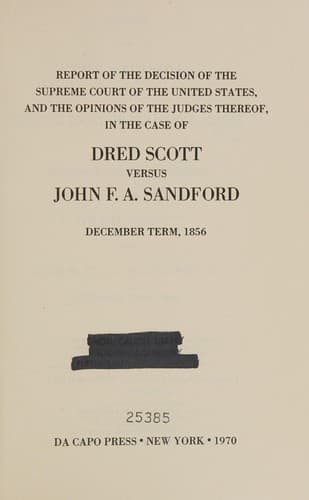
Report of the Decision of the Supreme Court of the United States, and the Opinions of the Judges Thereof, in the Case of Dred Scott versus John F. A. Sandford: December Term, 1856. — John Shaqi
Report of the Decision of the Supreme Court of the United States, and the Opinions of the Judges Thereof, in the Case of Dred Scott versus John F. A. Sandford: December Term, 1856.United States. Supreme Court
History
Report of the Decision of the Supreme Court of the United States, and the Opinions of the Judges Thereof, in the Case of Dred Scott versus John F. A. Sandford: December Term, 1856.
United States. Supreme Court
Scott, Dred, 1809-1858; Slavery -- United States
And it appears by the case of Crandall _v._ The State, reported in 10
Conn. Rep., 340, that upon an information filed against Prudence
Crandall for a violation of this law, one of the points raised in the
defence was, that the law was a violation of the Constitution of the
United States; and that the persons instructed, although of the
African race, were citizens of other States, and therefore entitled to
the rights and privileges of citizens in the State of Connecticut. But
Chief Justice Dagget, before whom the case was tried, held, that
persons of that description were not citizens of a State, within the
meaning of the word citizen in the Constitution of the United States,
and were not therefore entitled to the privileges and immunities of
citizens in other States.
The case was carried up to the Supreme Court of Errors of the State,
and the question fully argued there. But the case went off upon
another point, and no opinion was expressed on this question.
We have made this particular examination into the legislative and
judicial action of Connecticut, because, from the early hostility it
displayed to the slave trade on the coast of Africa, we may expect to
find the laws of that State as lenient and favorable to the subject
race as those of any other State in the Union; and if we find that at
the time the Constitution was adopted, they were not even there raised
to the rank of citizens, but were still held and treated as property,
and the laws relating to them passed with reference altogether to the
interest and convenience of the white race, we shall hardly find them
elevated to a higher rank anywhere else.
A brief notice of the laws of two other States, and we shall pass on
to other considerations.
By the laws of New Hampshire, collected and finally passed in 1815, no
one was permitted to be enrolled in the militia of the State, but free
white citizens; and the same provision is found in a subsequent
collection of the laws, made in 1855. Nothing could more strongly mark
the entire repudiation of the African race. The alien is excluded,
because, being born in a foreign country, he cannot be a member of the
community until he is naturalized. But why are the African race, born
in the State, not permitted to share in one of the highest duties of
the citizen? The answer is obvious; he is not, by the institutions and
laws of the State, numbered among its people. He forms no part of the
sovereignty of the State, and is not therefore called on to uphold and
defend it.
Public-domain text, read in full here on John Shaqi.
Reviews
Reviews
No reviews yet
Be the first to share your thoughts on this work.
Join the Discussion
Join the discussion
Sign in to leave a comment or review.
Sign InorCreate an account