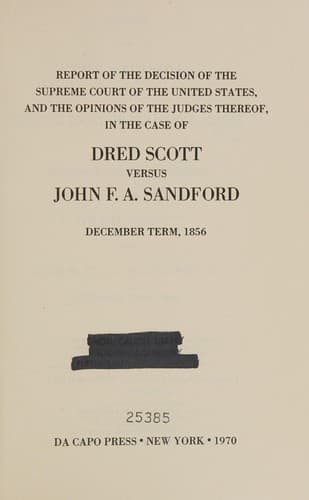
Report of the Decision of the Supreme Court of the United States, and the Opinions of the Judges Thereof, in the Case of Dred Scott versus John F. A. Sandford: December Term, 1856. — John Shaqi
Report of the Decision of the Supreme Court of the United States, and the Opinions of the Judges Thereof, in the Case of Dred Scott versus John F. A. Sandford: December Term, 1856.United States. Supreme Court
History
Report of the Decision of the Supreme Court of the United States, and the Opinions of the Judges Thereof, in the Case of Dred Scott versus John F. A. Sandford: December Term, 1856.
United States. Supreme Court
Scott, Dred, 1809-1858; Slavery -- United States
Again, in 1822, Rhode Island, in its revised code, passed a law
forbidding persons who were authorized to join persons in marriage,
from joining in marriage any white person with any negro, Indian, or
mulatto, under the penalty of two hundred dollars, and declaring all
such marriages absolutely null and void; and the same law was again
re-enacted in its revised code of 1844. So that, down to the
last-mentioned period, the strongest mark of inferiority and
degradation was fastened upon the African race in that State.
It would be impossible to enumerate and compress in the space usually
allotted to an opinion of a court, the various laws, marking the
condition of this race, which were passed from time to time after the
Revolution, and before and since the adoption of the Constitution of
the United States. In addition to those already referred to, it is
sufficient to say, that Chancellor Kent, whose accuracy and research
no one will question, states in the sixth edition of his Commentaries,
(published in 1848, 2 vol., 258, note _b_,) that in no part of the
country except Maine, did the African race, in point of fact,
participate equally with the whites in the exercise of civil and
political rights.
The legislation of the States therefore shows, in a manner not to be
mistaken, the inferior and subject condition of that race at the time
the Constitution was adopted, and long afterwards, throughout the
thirteen States by which that instrument was framed; and it is hardly
consistent with the respect due to these States, to suppose that they
regarded at that time, as fellow-citizens and members of the
sovereignty, a class of beings whom they had thus stigmatized; whom,
as we are bound, out of respect to the State sovereignties, to assume
they had deemed it just and necessary thus to stigmatize, and upon
whom they had impressed such deep and enduring marks of inferiority
and degradation; or, that when they met in convention to form the
Constitution, they looked upon them as a portion of their
constituents, or designed to include them in the provisions so
carefully inserted for the security and protection of the liberties
and rights of their citizens. It cannot be supposed that they intended
to secure to them rights, and privileges, and rank, in the new
political body throughout the Union, which every one of them denied
within the limits of its own dominion. More especially, it cannot be
believed that the large slaveholding States regarded them as included
in the word citizens, or would have consented to a Constitution which
might compel them to receive them in that character from another
State. For if they were so received, and entitled to the privileges
and immunities of citizens, it would exempt them from the operation of
the special laws and from the police regulations which they
considered to be necessary for their own safety. It would give to
persons of the negro race, who were recognised as citizens in any one
Public-domain text, read in full here on John Shaqi.
Reviews
Reviews
No reviews yet
Be the first to share your thoughts on this work.
Join the Discussion
Join the discussion
Sign in to leave a comment or review.
Sign InorCreate an account