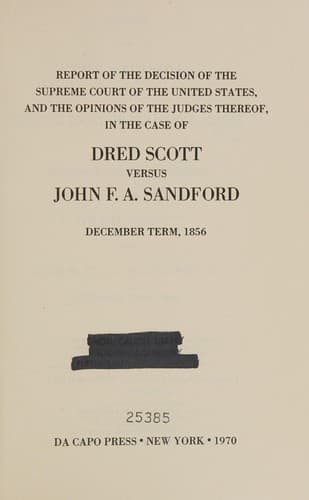
Report of the Decision of the Supreme Court of the United States, and the Opinions of the Judges Thereof, in the Case of Dred Scott versus John F. A. Sandford: December Term, 1856.United States. Supreme Court
History
Report of the Decision of the Supreme Court of the United States, and the Opinions of the Judges Thereof, in the Case of Dred Scott versus John F. A. Sandford: December Term, 1856.
United States. Supreme Court
Scott, Dred, 1809-1858; Slavery -- United States
State of the Union, the right to enter every other State whenever they
pleased, singly or in companies, without pass or passport, and without
obstruction, to sojourn there as long as they pleased, to go where
they pleased at every hour of the day or night without molestation,
unless they committed some violation of law for which a white man
would be punished; and it would give them the full liberty of speech
in public and in private upon all subjects upon which its own citizens
might speak; to hold public meetings upon political affairs, and to
keep and carry arms wherever they went. And all of this would be done
in the face of the subject race of the same color, both free and
slaves, and inevitably producing discontent and insubordination among
them, and endangering the peace and safety of the State.
It is impossible, it would seem, to believe that the great men of the
slaveholding States, who took so large a share in framing the
Constitution of the United States, and exercised so much influence in
procuring its adoption, could have been so forgetful or regardless of
their own safety and the safety of those who trusted and confided in
them.
Besides, this want of foresight and care would have been utterly
inconsistent with the caution displayed in providing for the admission
of new members into this political family. For, when they gave to the
citizens of each State the privileges and immunities of citizens in
the several States, they at the same time took from the several States
the power of naturalization, and confined that power exclusively to
the Federal Government. No State was willing to permit another State
to determine who should or should not be admitted as one of its
citizens, and entitled to demand equal rights and privileges with
their own people, within their own territories. The right of
naturalization was therefore, with one accord, surrendered by the
States, and confided to the Federal Government. And this power granted
to Congress to establish an uniform rule of _naturalization_ is, by
the well-understood meaning of the word, confined to persons born in a
foreign country, under a foreign Government. It is not a power to
raise to the rank of a citizen any one born in the United States, who,
from birth or parentage, by the laws of the country, belongs to an
inferior and subordinate class. And when we find the States guarding
themselves from the indiscreet or improper admission by other States
of emigrants from other countries, by giving the power exclusively to
Congress, we cannot fail to see that they could never have left with
the States a much more important power--that is, the power of
transforming into citizens a numerous class of persons, who in that
character would be much more dangerous to the peace and safety of a
large portion of the Union, than the few foreigners one of the States
might improperly naturalize. The Constitution upon its adoption
obviously took from the States all power by any subsequent legislation
Public-domain text, read in full here on John Shaqi.
Reviews
Reviews
No reviews yet
Be the first to share your thoughts on this work.
Join the Discussion
Join the discussion
Sign in to leave a comment or review.
Sign InorCreate an account