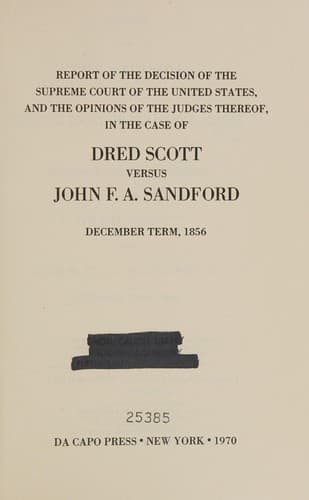
Report of the Decision of the Supreme Court of the United States, and the Opinions of the Judges Thereof, in the Case of Dred Scott versus John F. A. Sandford: December Term, 1856. — John Shaqi
Report of the Decision of the Supreme Court of the United States, and the Opinions of the Judges Thereof, in the Case of Dred Scott versus John F. A. Sandford: December Term, 1856.United States. Supreme Court
History
Report of the Decision of the Supreme Court of the United States, and the Opinions of the Judges Thereof, in the Case of Dred Scott versus John F. A. Sandford: December Term, 1856.
United States. Supreme Court
Scott, Dred, 1809-1858; Slavery -- United States
Legrand, therefore, raised no objection to the jurisdiction of the
court in the suit at law, because he was himself anxious to obtain the
judgment of the court upon his title. Consequently, there was nothing
in the record before the court to show that Darnall was of African
descent, and the usual judgment and award of execution was entered.
And Legrand thereupon filed his bill on the equity side of the Circuit
Court, stating that Darnall was born a slave, and had not been legally
emancipated, and could not therefore take the land devised to him, nor
make Legrand a good title; and praying an injunction to restrain
Darnall from proceeding to execution on the judgment, which was
granted. Darnall answered, averring in his answer that he was a free
man, and capable of conveying a good title. Testimony was taken on
this point, and at the hearing the Circuit Court was of opinion that
Darnall was a free man and his title good, and dissolved the
injunction and dismissed the bill; and that decree was affirmed here,
upon the appeal of Legrand.
Now, it is difficult to imagine how any question about the citizenship
of Darnall, or his right to sue in that character, can be supposed to
have arisen or been decided in that case. The fact that he was of
African descent was first brought before the court upon the bill in
equity. The suit at law had then passed into judgment and award of
execution, and the Circuit Court, as a court of law, had no longer any
authority over it. It was a valid and legal judgment, which the court
that rendered it had not the power to reverse or set aside. And unless
it had jurisdiction as a court of equity to restrain him from using
its process as a court of law, Darnall, if he thought proper, would
have been at liberty to proceed on his judgment, and compel the
payment of the money, although the allegations in the bill were true,
and he was incapable of making a title. No other court could have
enjoined him, for certainly no State equity court could interfere in
that way with the judgment of a Circuit Court of the United States.
Public-domain text, read in full here on John Shaqi.
Reviews
Reviews
No reviews yet
Be the first to share your thoughts on this work.
Join the Discussion
Join the discussion
Sign in to leave a comment or review.
Sign InorCreate an account