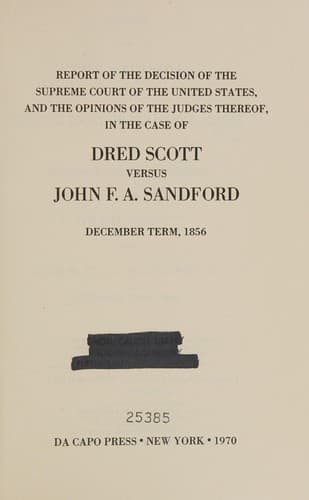
Report of the Decision of the Supreme Court of the United States, and the Opinions of the Judges Thereof, in the Case of Dred Scott versus John F. A. Sandford: December Term, 1856. — John Shaqi
Report of the Decision of the Supreme Court of the United States, and the Opinions of the Judges Thereof, in the Case of Dred Scott versus John F. A. Sandford: December Term, 1856.United States. Supreme Court
History
Report of the Decision of the Supreme Court of the United States, and the Opinions of the Judges Thereof, in the Case of Dred Scott versus John F. A. Sandford: December Term, 1856.
United States. Supreme Court
Scott, Dred, 1809-1858; Slavery -- United States
But the Circuit Court as a court of equity certainly had equity
jurisdiction over its own judgment as a court of law, without regard
to the character of the parties; and had not only the right, but it
was its duty--no matter who were the parties in the judgment--to
prevent them from proceeding to enforce it by execution, if the court
was satisfied that the money was not justly and equitably due. The
ability of Darnall to convey did not depend upon his citizenship, but
upon his title to freedom. And if he was free, he could hold and
convey property, by the laws of Maryland, although he was not a
citizen. But if he was by law still a slave, he could not. It was
therefore the duty of the court, sitting as a court of equity in the
latter case, to prevent him from using its process, as a court of
common law, to compel the payment of the purchase-money, when it was
evident that the purchaser must lose the land. But if he was free, and
could make a title, it was equally the duty of the court not to suffer
Legrand to keep the land, and refuse the payment of the money, upon
the ground that Darnall was incapable of suing or being sued as a
citizen in a court of the United States. The character or citizenship
of the parties had no connection with the question of jurisdiction,
and the matter in dispute had no relation to the citizenship of
Darnall. Nor is such a question alluded to in the opinion of the
court.
Besides, we are by no means prepared to say that there are not many
cases, civil as well as criminal, in which a Circuit Court of the
United States may exercise jurisdiction, although one of the African
race is a party; that broad question is not before the court. The
question with which we are now dealing is, whether a person of the
African race can be a citizen of the United States, and become thereby
entitled to a special privilege, by virtue of his title to that
character, and which, under the Constitution, no one but a citizen can
claim. It is manifest that the case of Legrand and Darnall has no
bearing on that question, and can have no application to the case now
before the court.
Public-domain text, read in full here on John Shaqi.
Reviews
Reviews
No reviews yet
Be the first to share your thoughts on this work.
Join the Discussion
Join the discussion
Sign in to leave a comment or review.
Sign InorCreate an account