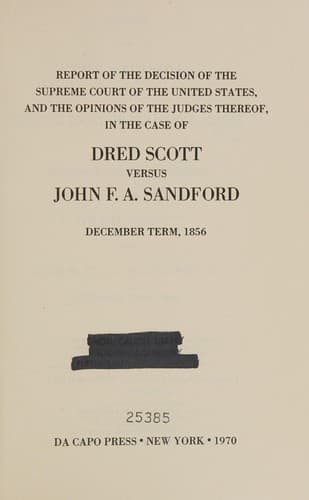
Report of the Decision of the Supreme Court of the United States, and the Opinions of the Judges Thereof, in the Case of Dred Scott versus John F. A. Sandford: December Term, 1856. — John Shaqi
Report of the Decision of the Supreme Court of the United States, and the Opinions of the Judges Thereof, in the Case of Dred Scott versus John F. A. Sandford: December Term, 1856.United States. Supreme Court
History
Report of the Decision of the Supreme Court of the United States, and the Opinions of the Judges Thereof, in the Case of Dred Scott versus John F. A. Sandford: December Term, 1856.
United States. Supreme Court
Scott, Dred, 1809-1858; Slavery -- United States
This case, however, strikingly illustrates the consequences that would
follow the construction of the Constitution which would give the power
contended for to a State. It would in effect give it also to an
individual. For if the father of young Darnall had manumitted him in
his lifetime, and sent him to reside in a State which recognised him
as a citizen, he might have visited and sojourned in Maryland when he
pleased, and as long as he pleased, as a citizen of the United States;
and the State officers and tribunals would be compelled, by the
paramount authority of the Constitution, to receive him and treat him
as one of its citizens, exempt from the laws and police of the State
in relation to a person of that description, and allow him to enjoy
all the rights and privileges of citizenship, without respect to the
laws of Maryland, although such laws were deemed by it absolutely
essential to its own safety.
The only two provisions which point to them and include them, treat
them as property, and make it the duty of the Government to protect
it; no other power, in relation to this race, is to be found in the
Constitution; and as it is a Government of special delegated powers,
no authority beyond these two provisions can be constitutionally
exercised. The Government of the United States had no right to
interfere for any other purpose but that of protecting the rights of
the owner, leaving it altogether with the several States to deal with
this race, whether emancipated or not, as each State may think
justice, humanity, and the interests and safety of society, require.
The States evidently intended to reserve this power exclusively to
themselves.
Public-domain text, read in full here on John Shaqi.
Reviews
Reviews
No reviews yet
Be the first to share your thoughts on this work.
Join the Discussion
Join the discussion
Sign in to leave a comment or review.
Sign InorCreate an account