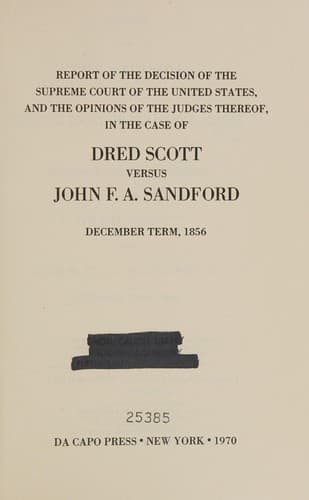
Report of the Decision of the Supreme Court of the United States, and the Opinions of the Judges Thereof, in the Case of Dred Scott versus John F. A. Sandford: December Term, 1856.United States. Supreme Court
History
Report of the Decision of the Supreme Court of the United States, and the Opinions of the Judges Thereof, in the Case of Dred Scott versus John F. A. Sandford: December Term, 1856.
United States. Supreme Court
Scott, Dred, 1809-1858; Slavery -- United States
No one, we presume, supposes that any change in public opinion or
feeling, in relation to this unfortunate race, in the civilized
nations of Europe or in this country, should induce the court to give
to the words of the Constitution a more liberal construction in their
favor than they were intended to bear when the instrument was framed
and adopted. Such an argument would be altogether inadmissible in any
tribunal called on to interpret it. If any of its provisions are
deemed unjust, there is a mode prescribed in the instrument itself by
which it may be amended; but while it remains unaltered, it must be
construed now as it was understood at the time of its adoption. It is
not only the same in words, but the same in meaning, and delegates the
same powers to the Government, and reserves and secures the same
rights and privileges to the citizen; and as long as it continues to
exist in its present form, it speaks not only in the same words, but
with the same meaning and intent with which it spoke when it came from
the hands of its framers, and was voted on and adopted by the people
of the United States. Any other rule of construction would abrogate
the judicial character of this court, and make it the mere reflex of
the popular opinion or passion of the day. This court was not created
by the Constitution for such purposes. Higher and graver trusts have
been confided to it, and it must not falter in the path of duty.
What the construction was at that time, we think can hardly admit of
doubt. We have the language of the Declaration of Independence and of
the Articles of Confederation, in addition to the plain words of the
Constitution itself; we have the legislation of the different States,
before, about the time, and since, the Constitution was adopted; we
have the legislation of Congress, from the time of its adoption to a
recent period; and we have the constant and uniform action of the
Executive Department, all concurring together, and leading to the same
result. And if anything in relation to the construction of the
Constitution can be regarded as settled, it is that which we now give
to the word "citizen" and the word "people."
And upon a full and careful consideration of the subject, the court
is of opinion, that, upon the facts stated in the plea in abatement,
Dred Scott was not a citizen of Missouri within the meaning of the
Constitution of the United States, and not entitled as such to sue in
its courts; and, consequently, that the Circuit Court had no
jurisdiction of the case, and that the judgment on the plea in
abatement is erroneous.
Public-domain text, read in full here on John Shaqi.
Reviews
Reviews
No reviews yet
Be the first to share your thoughts on this work.
Join the Discussion
Join the discussion
Sign in to leave a comment or review.
Sign InorCreate an account