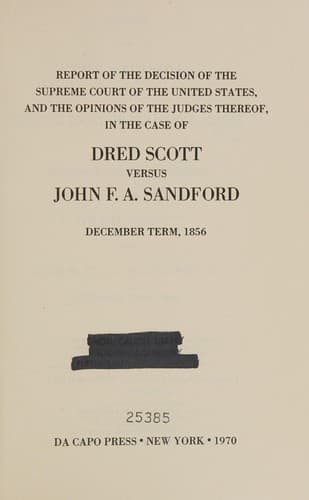
Report of the Decision of the Supreme Court of the United States, and the Opinions of the Judges Thereof, in the Case of Dred Scott versus John F. A. Sandford: December Term, 1856.United States. Supreme Court
History
Report of the Decision of the Supreme Court of the United States, and the Opinions of the Judges Thereof, in the Case of Dred Scott versus John F. A. Sandford: December Term, 1856.
United States. Supreme Court
Scott, Dred, 1809-1858; Slavery -- United States
We are aware that doubts are entertained by some of the members of the
court, whether the plea in abatement is legally before the court upon
this writ of error; but if that plea is regarded as waived, or out of
the case upon any other ground, yet the question as to the
jurisdiction of the Circuit Court is presented on the face of the bill
of exception itself, taken by the plaintiff at the trial; for he
admits that he and his wife were born slaves, but endeavors to make
out his title to freedom and citizenship by showing that they were
taken by their owner to certain places, hereinafter mentioned, where
slavery could not by law exist, and that they thereby became free, and
upon their return to Missouri became citizens of that State.
Now, if the removal of which he speaks did not give them their
freedom, then by his own admission he is still a slave; and whatever
opinions may be entertained in favor of the citizenship of a free
person of the African race, no one supposes that a slave is a citizen
of the State or of the United States. If, therefore, the acts done by
his owner did not make them free persons, he is still a slave, and
certainly incapable of suing in the character of a citizen.
The principle of law is too well settled to be disputed, that a court
can give no judgment for either party, where it has no jurisdiction;
and if, upon the showing of Scott himself, it appeared that he was
still a slave, the case ought to have been dismissed, and the judgment
against him and in favor of the defendant for costs, is, like that on
the plea in abatement, erroneous, and the suit ought to have been
dismissed by the Circuit Court for want of jurisdiction in that court.
But, before we proceed to examine this part of the case, it may be
proper to notice an objection taken to the judicial authority of this
court to decide it; and it has been said, that as this court has
decided against the jurisdiction of the Circuit Court on the plea in
abatement, it has no right to examine any question presented by the
exception; and that anything it may say upon that part of the case
will be extra-judicial, and mere obiter dicta.
This is a manifest mistake; there can be no doubt as to the
jurisdiction of this court to revise the judgment of a Circuit Court,
and to reverse it for any error apparent on the record, whether it be
the error of giving judgment in a case over which it had no
jurisdiction, or any other material error; and this, too, whether
there is a plea in abatement or not.
Public-domain text, read in full here on John Shaqi.
Reviews
Reviews
No reviews yet
Be the first to share your thoughts on this work.
Join the Discussion
Join the discussion
Sign in to leave a comment or review.
Sign InorCreate an account