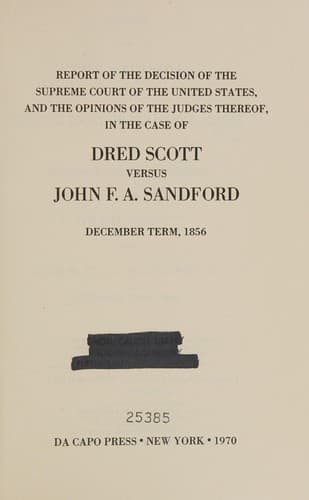
Report of the Decision of the Supreme Court of the United States, and the Opinions of the Judges Thereof, in the Case of Dred Scott versus John F. A. Sandford: December Term, 1856.United States. Supreme Court
History
Report of the Decision of the Supreme Court of the United States, and the Opinions of the Judges Thereof, in the Case of Dred Scott versus John F. A. Sandford: December Term, 1856.
United States. Supreme Court
Scott, Dred, 1809-1858; Slavery -- United States
The objection appears to have arisen from confounding writs of error
to a State court, with writs of error to a Circuit Court of the United
States. Undoubtedly, upon a writ of error to a State court, unless the
record shows a case that gives jurisdiction, the case must be
dismissed for want of jurisdiction in _this court_. And if it is
dismissed on that ground, we have no right to examine and decide upon
any question presented by the bill of exceptions, or any other part of
the record. But writs of error to a State court, and to a Circuit
Court of the United States, are regulated by different laws, and stand
upon entirely different principles. And in a writ of error to a
Circuit Court of the United States, the whole record is before this
court for examination and decision; and if the sum in controversy is
large enough to give jurisdiction, it is not only the right, but it is
the judicial duty of the court, to examine the whole case as presented
by the record; and if it appears upon its face that any material error
or errors have been committed by the court below, it is the duty of
this court to reverse the judgment, and remand the case. And certainly
an error in passing a judgment upon the merits in favor of either
party, in a case which it was not authorized to try, and over which it
had no jurisdiction, is as grave an error as a court can commit.
The plea in abatement is not a plea to the jurisdiction of this court,
but to the jurisdiction of the Circuit Court. And it appears by the
record before us, that the Circuit Court committed an error, in
deciding that it had jurisdiction, upon the facts in the case,
admitted by the pleadings. It is the duty of the appellate tribunal to
correct this error; but that could not be done by dismissing the case
for want of jurisdiction here--for that would leave the erroneous
judgment in full force, and the injured party without remedy. And the
appellate court therefore exercises the power for which alone
appellate courts are constituted, by reversing the judgment of the
court below for this error. It exercises its proper and appropriate
jurisdiction over the judgment and proceedings of the Circuit Court,
as they appear upon the record brought up by the writ of error.
Public-domain text, read in full here on John Shaqi.
Reviews
Reviews
No reviews yet
Be the first to share your thoughts on this work.
Join the Discussion
Join the discussion
Sign in to leave a comment or review.
Sign InorCreate an account