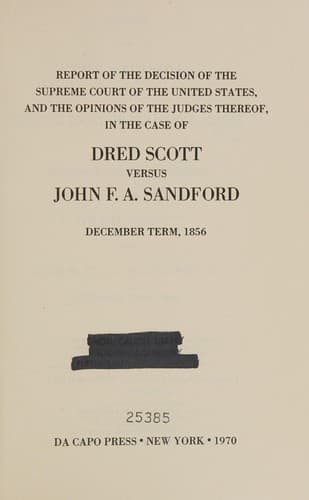
Report of the Decision of the Supreme Court of the United States, and the Opinions of the Judges Thereof, in the Case of Dred Scott versus John F. A. Sandford: December Term, 1856.United States. Supreme Court
History
Report of the Decision of the Supreme Court of the United States, and the Opinions of the Judges Thereof, in the Case of Dred Scott versus John F. A. Sandford: December Term, 1856.
United States. Supreme Court
Scott, Dred, 1809-1858; Slavery -- United States
The correction of one error in the court below does not deprive the
appellate court of the power of examining further into the record, and
correcting any other material errors which may have been committed by
the inferior court. There is certainly no rule of law--nor any
practice--nor any decision of a court--which even questions this
power in the appellate tribunal. On the contrary, it is the daily
practice of this court, and of all appellate courts where they reverse
the judgment of an inferior court for error, to correct by its
opinions whatever errors may appear on the record material to the
case; and they have always held it to be their duty to do so where the
silence of the court might lead to misconstruction or future
controversy, and the point has been relied on by either side, and
argued before the court.
In the case before us, we have already decided that the Circuit Court
erred in deciding that it had jurisdiction upon the facts admitted by
the pleadings. And it appears that, in the further progress of the
case, it acted upon the erroneous principle it had decided on the
pleadings, and gave judgment for the defendant, where, upon the facts
admitted in the exception, it had no jurisdiction.
We are at a loss to understand upon what principle of law, applicable
to appellate jurisdiction, it can be supposed that this court has not
judicial authority to correct the last-mentioned error, because they
had before corrected the former; or by what process of reasoning it
can be made out, that the error of an inferior court in actually
pronouncing judgment for one of the parties, in a case in which it had
no jurisdiction, cannot be looked into or corrected by this court,
because we have decided a similar question presented in the pleadings.
The last point is distinctly presented by the facts contained in the
plaintiff's own bill of exceptions, which he himself brings here by
this writ of error. It was the point which chiefly occupied the
attention of the counsel on both sides in the argument--and the
judgment which this court must render upon both errors is precisely
the same. It must, in each of them, exercise jurisdiction over the
judgment, and reverse it for the errors committed by the court below;
and issue a mandate to the Circuit Court to conform its judgment to
the opinion pronounced by this court, by dismissing the case for want
of jurisdiction in the Circuit Court. This is the constant and
invariable practice of this court, where it reverses a judgment for
want of jurisdiction in the Circuit Court.
Public-domain text, read in full here on John Shaqi.
Reviews
Reviews
No reviews yet
Be the first to share your thoughts on this work.
Join the Discussion
Join the discussion
Sign in to leave a comment or review.
Sign InorCreate an account