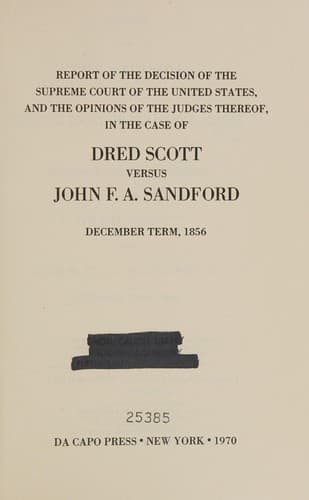
Report of the Decision of the Supreme Court of the United States, and the Opinions of the Judges Thereof, in the Case of Dred Scott versus John F. A. Sandford: December Term, 1856.United States. Supreme Court
History
Report of the Decision of the Supreme Court of the United States, and the Opinions of the Judges Thereof, in the Case of Dred Scott versus John F. A. Sandford: December Term, 1856.
United States. Supreme Court
Scott, Dred, 1809-1858; Slavery -- United States
If the question raised by it is legally before us, and the court
should be of opinion that the facts stated in it disqualify the
plaintiff from becoming a citizen, in the sense in which that word is
used in the Constitution of the United States, then the judgment of
the Circuit Court is erroneous, and must be reversed.
It is suggested, however, that this plea is not before us; and that as
the judgment in the court below on this plea was in favor of the
plaintiff, he does not seek to reverse it, or bring it before the
court for revision by his writ of error; and also that the defendant
waived this defence by pleading over, and thereby admitted the
jurisdiction of the court.
But, in making this objection, we think the peculiar and limited
jurisdiction of courts of the United States has not been adverted to.
This peculiar and limited jurisdiction has made it necessary, in these
courts, to adopt different rules and principles of pleading, so far as
jurisdiction is concerned, from those which regulate courts of common
law in England, and in the different States of the Union which have
adopted the common-law rules.
In these last-mentioned courts, where their character and rank are
analogous to that of a Circuit Court of the United States; in other
words, where they are what the law terms courts of general
jurisdiction; they are presumed to have jurisdiction, unless the
contrary appears. No averment in the pleadings of the plaintiff is
necessary, in order to give jurisdiction. If the defendant objects to
it, he must plead it specially, and unless the fact on which he relies
is found to be true by a jury, or admitted to be true by the
plaintiff, the jurisdiction cannot be disputed in an appellate court.
Now, it is not necessary to inquire whether in courts of that
description a party who pleads over in bar, when a plea to the
jurisdiction has been ruled against him, does or does not waive his
plea; nor whether upon a judgment in his favor on the pleas in bar,
and a writ of error brought by the plaintiff, the question upon the
plea in abatement would be open for revision in the appellate court.
Cases that may have been decided in such courts, or rules that may
have been laid down by common-law pleaders, can have no influence in
the decision in this court. Because, under the Constitution and laws
of the United States, the rules which govern the pleadings in its
courts, in questions of jurisdiction, stand on different principles
and are regulated by different laws.
Public-domain text, read in full here on John Shaqi.
Reviews
Reviews
No reviews yet
Be the first to share your thoughts on this work.
Join the Discussion
Join the discussion
Sign in to leave a comment or review.
Sign InorCreate an account