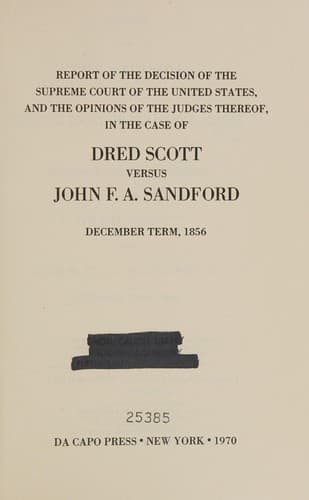
Report of the Decision of the Supreme Court of the United States, and the Opinions of the Judges Thereof, in the Case of Dred Scott versus John F. A. Sandford: December Term, 1856.United States. Supreme Court
History
Report of the Decision of the Supreme Court of the United States, and the Opinions of the Judges Thereof, in the Case of Dred Scott versus John F. A. Sandford: December Term, 1856.
United States. Supreme Court
Scott, Dred, 1809-1858; Slavery -- United States
This difference arises, as we have said, from the peculiar character
of the Government of the United States. For although it is sovereign
and supreme in its appropriate sphere of action, yet it does not
possess all the powers which usually belong to the sovereignty of a
nation. Certain specified powers, enumerated in the Constitution, have
been conferred upon it; and neither the legislative, executive, nor
judicial departments of the Government can lawfully exercise any
authority beyond the limits marked out by the Constitution. And in
regulating the judicial department, the cases in which the courts of
the United States shall have jurisdiction are particularly and
specifically enumerated and defined; and they are not authorized to
take cognizance of any case which does not come within the description
therein specified. Hence, when a plaintiff sues in a court of the
United States, it is necessary that he should show, in his pleading,
that the suit he brings is within the jurisdiction of the court, and
that he is entitled to sue there. And if he omits to do this, and
should, by any oversight of the Circuit Court, obtain a judgment in
his favor, the judgment would be reversed in the appellate court for
want of jurisdiction in the court below. The jurisdiction would not be
presumed, as in the case of a common-law English or State court,
unless the contrary appeared. But the record, when it comes before the
appellate court, must show, affirmatively, that the inferior court had
authority, under the Constitution, to hear and determine the case. And
if the plaintiff claims a right to sue in a Circuit Court of the
United States, under that provision of the Constitution which gives
jurisdiction in controversies between citizens of different States, he
must distinctly aver in his pleading that they are citizens of
different States; and he cannot maintain his suit without showing that
fact in the pleadings.
This point was decided in the case of Bingham _v._ Cabot, (in 3 Dall.,
382,) and ever since adhered to by the court. And in Jackson _v._
Ashton, (8 Pet., 148,) it was held that the objection to which it was
open could not be waived by the opposite party, because consent of
parties could not give jurisdiction.
It is needless to accumulate cases on this subject. Those already
referred to, and the cases of Capron _v._ Van Noorden, (in 2 Cr.,
126,) and Montalet _v._ Murray, (4 Cr., 46,) are sufficient to show
the rule of which we have spoken. The case of Capron _v._ Van Noorden
strikingly illustrates the difference between a common-law court and a
court of the United States.
Public-domain text, read in full here on John Shaqi.
Reviews
Reviews
No reviews yet
Be the first to share your thoughts on this work.
Join the Discussion
Join the discussion
Sign in to leave a comment or review.
Sign InorCreate an account