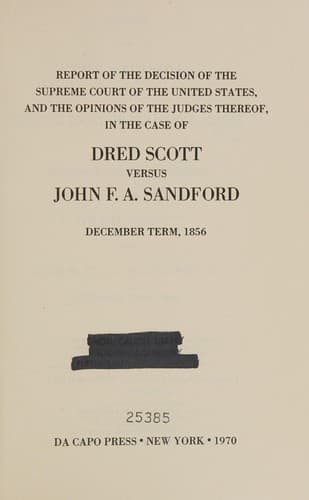
Report of the Decision of the Supreme Court of the United States, and the Opinions of the Judges Thereof, in the Case of Dred Scott versus John F. A. Sandford: December Term, 1856. — John Shaqi
Report of the Decision of the Supreme Court of the United States, and the Opinions of the Judges Thereof, in the Case of Dred Scott versus John F. A. Sandford: December Term, 1856.United States. Supreme Court
History
Report of the Decision of the Supreme Court of the United States, and the Opinions of the Judges Thereof, in the Case of Dred Scott versus John F. A. Sandford: December Term, 1856.
United States. Supreme Court
Scott, Dred, 1809-1858; Slavery -- United States
Judge Story observes, in his Conflict of Laws, (p. 24,) "that a State
may prohibit the operation of all foreign laws, and the rights growing
out of them, within its territories." "And that when its code speaks
positively on the subject, it must be obeyed by all persons who are
within reach of its sovereignty; when its customary unwritten or
common law speaks directly on the subject, it is equally to be
obeyed."
Nations, from convenience and comity, and from mutual interest, and a
sort of moral necessity to do justice, recognise and administer the
laws of other countries. But, of the nature, extent, and utility, of
them, respecting property, or the state and condition of persons
within her territories, each nation judges for itself; and is never
bound, even upon the ground of comity, to recognise them, if
prejudicial to her own interests. The recognition is purely from
comity, and not from any absolute or paramount obligation.
Judge Story again observes, (398,) "that the true foundation and
extent of the obligation of the laws of one nation within another is
the voluntary consent of the latter, and is inadmissible when they are
contrary to its known interests." And he adds, "in the silence of any
positive rule affirming or denying or restraining the operation of the
foreign laws, courts of justice presume the tacit adoption of them by
their own Government, unless they are repugnant to its policy or
prejudicial to its interests." (See also 2 Kent Com., p. 457; 13
Peters, 519, 589.)
These principles fully establish, that it belongs to the sovereign
State of Missouri to determine by her laws the question of slavery
within her jurisdiction, subject only to such limitations as may be
found in the Federal Constitution; and, further, that the laws of
other States of the Confederacy, whether enacted by their Legislatures
or expounded by their courts, can have no operation within her
territory, or affect rights growing out of her own laws on the
subject. This is the necessary result of the independent and sovereign
character of the State. The principle is not peculiar to the State of
Missouri, but is equally applicable to each State belonging to the
Confederacy. The laws of each have no extra-territorial operation
within the jurisdiction of another, except such as may be voluntarily
conceded by her laws or courts of justice. To the extent of such
concession upon the rule of comity of nations, the foreign law may
operate, as it then becomes a part of the municipal law of the State.
When determined that the foreign law shall have effect, the municipal
law of the State retires, and gives place to the foreign law.
Public-domain text, read in full here on John Shaqi.
Reviews
Reviews
No reviews yet
Be the first to share your thoughts on this work.
Join the Discussion
Join the discussion
Sign in to leave a comment or review.
Sign InorCreate an account