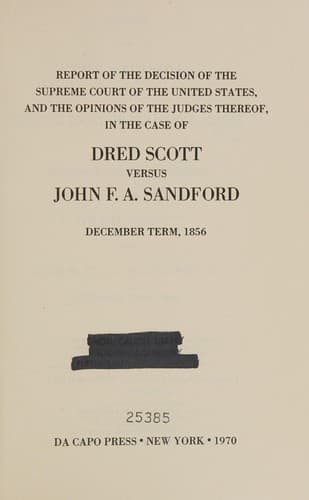
Report of the Decision of the Supreme Court of the United States, and the Opinions of the Judges Thereof, in the Case of Dred Scott versus John F. A. Sandford: December Term, 1856.United States. Supreme Court
History
Report of the Decision of the Supreme Court of the United States, and the Opinions of the Judges Thereof, in the Case of Dred Scott versus John F. A. Sandford: December Term, 1856.
United States. Supreme Court
Scott, Dred, 1809-1858; Slavery -- United States
If, however, the fact of citizenship is averred in the declaration,
and the defendant does not deny it, and put it in issue by plea in
abatement, he cannot offer evidence at the trial to disprove it, and
consequently cannot avail himself of the objection in the appellate
court, unless the defect should be apparent in some other part of the
record. For if there is no plea in abatement, and the want of
jurisdiction does not appear in any other part of the transcript
brought up by the writ of error, the undisputed averment of
citizenship in the declaration must be taken in this court to be true.
In this case, the citizenship is averred, but it is denied by the
defendant in the manner required by the rules of pleading; and the
fact upon which the denial is based is admitted by the demurrer. And,
if the plea and demurrer, and judgment of the court below upon it, are
before us upon this record, the question to be decided is, whether the
facts stated in the plea are sufficient to show that the plaintiff is
not entitled to sue as a citizen in a court of the United States.
We think they are before us. The plea in abatement and the judgment of
the court upon it, are a part of the judicial proceedings in the
Circuit Court, and are there recorded as such; and a writ of error
always brings up to the superior court the whole record of the
proceedings in the court below. And in the case of the United States
_v._ Smith, (11 Wheat., 172,) this court said, that the case being
brought up by writ of error, the whole record was under the
consideration of this court. And this being the case in the present
instance, the plea in abatement is necessarily under consideration;
and it becomes, therefore, our duty to decide whether the facts stated
in the plea are or are not sufficient to show that the plaintiff is
not entitled to sue as a citizen in a court of the United States.
This is certainly a very serious question, and one that now for the
first time has been brought for decision before this court. But it is
brought here by those who have a right to bring it, and it is our duty
to meet it and decide it.
The question is simply this: Can a negro, whose ancestors were
imported into this country, and sold as slaves, become a member of the
political community formed and brought into existence by the
Constitution of the United States, and as such become entitled to all
the rights, and privileges, and immunities, guarantied by that
instrument to the citizen? One of which rights is the privilege of
suing in a court of the United States in the cases specified in the
Constitution.
Public-domain text, read in full here on John Shaqi.
Reviews
Reviews
No reviews yet
Be the first to share your thoughts on this work.
Join the Discussion
Join the discussion
Sign in to leave a comment or review.
Sign InorCreate an account