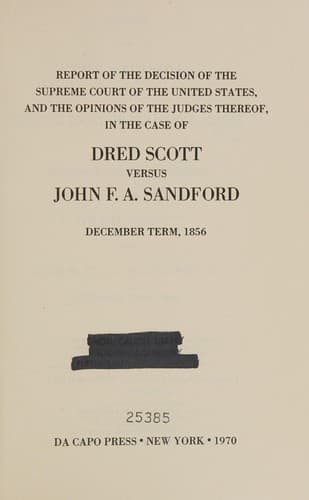
Report of the Decision of the Supreme Court of the United States, and the Opinions of the Judges Thereof, in the Case of Dred Scott versus John F. A. Sandford: December Term, 1856.United States. Supreme Court
History
Report of the Decision of the Supreme Court of the United States, and the Opinions of the Judges Thereof, in the Case of Dred Scott versus John F. A. Sandford: December Term, 1856.
United States. Supreme Court
Scott, Dred, 1809-1858; Slavery -- United States
In view of these principles, let us examine a little more closely the
doctrine of those who maintain that the law of Missouri is not to
govern the status and condition of the plaintiff. They insist that the
removal and temporary residence with his master in Illinois, where
slavery is inhibited, had the effect to set him free, and that the
same effect is to be given to the law of Illinois, within the State of
Missouri, after his return. Why was he set free in Illinois? Because
the law of Missouri, under which he was held as a slave, had no
operation by its own force extra-territorially; and the State of
Illinois refused to recognise its effect within her limits, upon
principles of comity, as a state of slavery was inconsistent with her
laws, and contrary to her policy. But, how is the case different on
the return of the plaintiff to the State of Missouri? Is she bound to
recognise and enforce the law of Illinois? For, unless she is, the
status and condition of the slave upon his return remains the same as
originally existed. Has the law of Illinois any greater force within
the jurisdiction of Missouri, than the laws of the latter within that
of the former? Certainly not. They stand upon an equal footing.
Neither has any force extra-territorially, except what may be
voluntarily conceded to them.
It has been supposed, by the counsel for the plaintiff, that a rule
laid down by Huberus had some bearing upon this question. Huberus
observes that "personal qualities, impressed by the laws of any place,
surround and accompany the person wherever he goes, with this effect:
that in every place he enjoys and is subject to the same law which
other persons of his class elsewhere enjoy or are subject to." (De
Confl. Leg., lib. 1, tit. 3, sec. 12; 4 Dallas, 375 n.; 1 Story Con.
Laws, pp. 59, 60.)
The application sought to be given to the rule was this: that as Dred
Scott was free while residing in the State of Illinois, by the laws of
that State, on his return to the State of Missouri he carried with him
the personal qualities of freedom, and that the same effect must be
given to his status there as in the former State. But the difficulty
in the case is in the total misapplication of the rule.
These personal qualities, to which Huberus refers, are those impressed
upon the individual by the law of the domicil; it is this that the
author claims should be permitted to accompany the person into
whatever country he might go, and should supersede the law of the
place where he had taken up a temporary residence.
Public-domain text, read in full here on John Shaqi.
Reviews
Reviews
No reviews yet
Be the first to share your thoughts on this work.
Join the Discussion
Join the discussion
Sign in to leave a comment or review.
Sign InorCreate an account