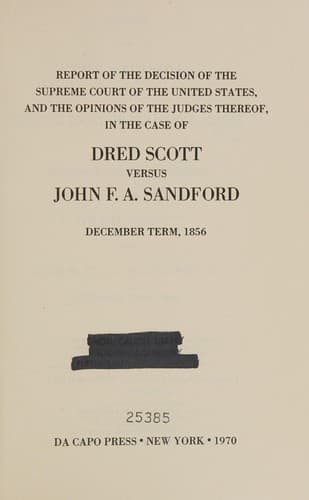
Report of the Decision of the Supreme Court of the United States, and the Opinions of the Judges Thereof, in the Case of Dred Scott versus John F. A. Sandford: December Term, 1856.United States. Supreme Court
History
Report of the Decision of the Supreme Court of the United States, and the Opinions of the Judges Thereof, in the Case of Dred Scott versus John F. A. Sandford: December Term, 1856.
United States. Supreme Court
Scott, Dred, 1809-1858; Slavery -- United States
Now, as the domicil of Scott was in the State of Missouri, where he
was a slave, and from whence he was taken by his master into Illinois
for a temporary residence, according to the doctrine of Huberus, the
law of his domicil would have accompanied him, and during his
residence there he would remain in the same condition as in the State
of Missouri. In order to have given effect to the rule, as claimed in
the argument, it should have been first shown that a domicil had been
acquired in the free State, which cannot be pretended upon the agreed
facts in the case. But the true answer to the doctrine of Huberus is,
that the rule, in any aspect in which it may be viewed, has no bearing
upon either side of the question before us, even if conceded to the
extent laid down by the author; for he admits that foreign Governments
give effect to these laws of the domicil no further than they are
consistent with their own laws, and not prejudicial to their own
subjects; in other words, their force and effect depend upon the law
of comity of the foreign Government. We should add, also, that this
general rule of Huberus, referred to, has not been admitted in the
practice of nations, nor is it sanctioned by the most approved jurists
of international law. (Story Con., sec. 91, 96, 103, 104; 2 Kent.
Com., p. 457, 458; 1 Burge Con. Laws, pp. 12, 127.)
We come now to the decision of this court in the case of Strader et
al. _v._ Graham, (10 How., p. 2.) The case came up from the Court of
Appeals, in the State of Kentucky. The question in the case was,
whether certain slaves of Graham, a resident of Kentucky, who had been
employed temporarily at several places in the State of Ohio, with
their master's consent, and had returned to Kentucky into his service,
had thereby become entitled to their freedom. The Court of Appeals
held that they had not. The case was brought to this court under the
twenty-fifth section of the judiciary act. This court held that it had
no jurisdiction, for the reason, the question was one that belonged
exclusively to the State of Kentucky. The Chief Justice, in delivering
the opinion of the court, observed that "every State has an undoubted
right to determine the status or domestic and social condition of the
persons domiciled within its territory, except in so far as the powers
of the States in this respect are restrained, or duties and
obligations imposed upon them, by the Constitution of the United
States. There is nothing in the Constitution of the United States, he
observes, that can in any degree control the law of Kentucky upon this
subject. And the condition of the negroes, therefore, as to freedom or
slavery, after their return, depended altogether upon the laws of that
State, and could not be influenced by the laws of Ohio. It was
exclusively in the power of Kentucky to determine, for herself,
whether their employment in another State should or should not make
them free on their return."
Public-domain text, read in full here on John Shaqi.
Reviews
Reviews
No reviews yet
Be the first to share your thoughts on this work.
Join the Discussion
Join the discussion
Sign in to leave a comment or review.
Sign InorCreate an account