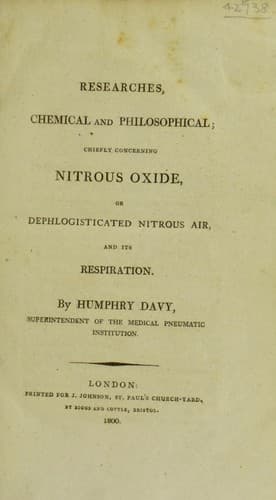
Researches Chemical and Philosophical; Chiefly concerning nitrous oxide: or dephlogisticated nitrous air and its respiration — John Shaqi
Researches Chemical and Philosophical; Chiefly concerning nitrous oxide: or dephlogisticated nitrous air and its respirationDavy, Humphry, Sir
Science
Researches Chemical and Philosophical; Chiefly concerning nitrous oxide: or dephlogisticated nitrous air and its respiration
Davy, Humphry, Sir
Nitrous oxide
[9] When copper is dissolved in dilute nitrous acid, certain quantities
of nitrogene are generally produced, likewise the nitrous gas carries
off in solution some nitrous acid.
[10] This airholder, considered as a pneumatic instrument, is of
greater importance, and capable of a more extensive application than
any other. It was invented by Mr. W. CLAYFIELD, and in its form is
analogous to Mr. WATT’S hydraulic bellows, consisting of a glass bell
playing under the pressure of the atmosphere, in a space between two
cylinders filled with mercury. A particular account of it will be given
in the appendix.
They were weighed in a glass globe, of the capacity of 108 cubic
inches, which with the small glass stop-cock affixed to it, was equal,
when filled with atmospheric air, to 1755 grains. The balance that I
employed, when loaded with a pound, turned with less than one eighth of
a grain.
Into a mercurial airholder, of the capacity of 200 cubic inches, 160
cubic inches of nitrous gas were thrown from a solution of mercury in
nitrous acid.
70 measures of this were agitated for some minutes in a solution of
sulphate of iron,[11] till the diminution was complete. The nitrogene
remaining hardly filled a measure; and if we suppose with Humbolt[12]
that a very small portion of it was absorbed with the nitrous gas, the
whole quantity it contained may be estimated at 0,0142, or ¹/₇₀.
[11] This absorption will be hereafter particularly treated of.
[12] Annales de Chimie. Tome xviii. page 139.
75 cubic inches received from the airholder into an exhausted balloon,
increased it in weight 25,5 grains; thermometer being 56°, and
barometer 30,9. And allowing for the small quantity of nitrogene in the
gas, 100 cubic inches of it will weigh 34.3 grains.
One hundred and thirty cubic inches of oxygene were procured from oxide
of manganese and sulphuric acid, by heat, and received in another
mercurial airholder.
10 measures of it, mingled with 26 of the nitrous gas, gave, after
the residuum was exposed to solution of sulphate of iron, rather more
than one measure. Hence we may conclude that it contained about 0,1
nitrogene.
60 cubic inches of it weighed 20,75 grains; and accounting for the
nitrogene contained in these, 100 grains of pure oxygene will weigh
35,09 grains.
Atmospherical air was decomposed by nitrous gas in excess; and the
residuum washed with solution of sulphate of iron till the Nitrogene
remained pure; 87 cubic inches of it weighed 26,5 grains, thermometer
being 48°, barometer 30,1; 100 will consequently weigh 30,45.
90 cubic inches of the air of the laboratory not deprived of its
carbonic acid, weighed 28,75 grains; thermometer 53, barometer 30: 100
cubic inches will consequently weigh 31,9.[13] 16 measures of this air,
with 16 nitrous gas, of known composition, diminished to 19. Hence it
contained about,26 oxygene.[14]
Public-domain text, read in full here on John Shaqi.
Reviews
Reviews
No reviews yet
Be the first to share your thoughts on this work.
Join the Discussion
Join the discussion
Sign in to leave a comment or review.
Sign InorCreate an account