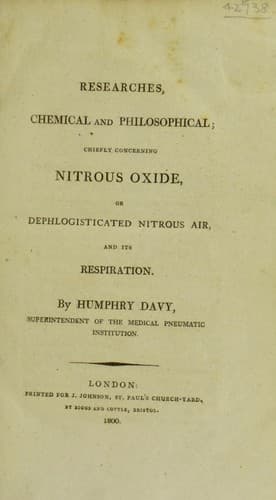
Researches Chemical and Philosophical; Chiefly concerning nitrous oxide: or dephlogisticated nitrous air and its respiration — John Shaqi
Researches Chemical and Philosophical; Chiefly concerning nitrous oxide: or dephlogisticated nitrous air and its respirationDavy, Humphry, Sir
Science
Researches Chemical and Philosophical; Chiefly concerning nitrous oxide: or dephlogisticated nitrous air and its respiration
Davy, Humphry, Sir
Nitrous oxide
VII. To the stop-cock of the upper cylinder of the mercurial airholder,
a capillary tube was adapted, bent so as to be capable of introduction
into an orifice in the stopper of a graduated phial similar to that
employed for mingling acids with water, and sufficiently long to reach
the bottom. With another orifice in the stopper of the phial was
connected a similar tube curved, for the purpose of containing a fluid,
and of increased diameter at the extremity.[29]
50 cubic inches of pure nitrous gas[30] were thrown into the mercurial
apparatus. The graduated phial, containing 90 grains of nitric acid, of
specific gravity 1,5, was placed on the top of the airholding cylinder,
and made to communicate with it by means of the stop-cock and first
tube. Into the second tube a small quantity of solution of potash was
placed. When all the junctures were carefully cemented, by pressing on
the airholder, the nitrous gas was slowly passed into the phial, and
absorbed by the nitrous acid it contained; whilst the small quantities
of nitrogene evolved, slowly drove forward the solution in the curved
tube; from the height of which, as compared with that of the mercury in
the conducing tube, the pressure on the air in the cylinder was known.
In proportion as the nitrous gas was absorbed, the phial became warm,
and the acid changed color; it first became straw-colored, then pale
yellow, and when about 7½ cubic inches had been combined with it,
bright yellow. It had gained in weight nearly 3 grains, and was become
of specific gravity 1,496.
[29] The outline only of this apparatus is given here, as far as was
necessary to make the experiment intelligible; a detailed account of
it, and of its general application, will be given in the appendix.
[30] That is, from nitrous acid and mercury.
This experiment afforded me an approximation to the real difference
between nitric and yellow nitrous acid; and learning from it that
nitric acid was diminished in specific gravity by combination with
nitrous gas, I procured a pale acid of specific gravity 1,504.[31]
After this acid had been combined in the same manner as before, with
about 8 cubic inches of nitrous gas,[32] it became nearly of specific
gravity 1,5, and had gained in weight about 3 grains.
[31] A pale acid of 1.52, by being converted into yellow acid, became
nearly of specific gravity 15,1.
[32] It is impossible to ascertain the quantity of gas absorbed to more
than a quarter of a cubic inch, as the first portions of nitrous gas
thrown into the graduated cylinder are combined with the oxygene of the
common air in it, to form nitrous acid, and hence the slight excess of
weight.
Assuming the accuracy of this experiment as a foundation for
calculation, I endeavoured in the same manner to ascertain the
differences in the composition of the orange colored acids, and the
acids containing still larger proportions of nitrous gas.
Public-domain text, read in full here on John Shaqi.
Reviews
Reviews
No reviews yet
Be the first to share your thoughts on this work.
Join the Discussion
Join the discussion
Sign in to leave a comment or review.
Sign InorCreate an account