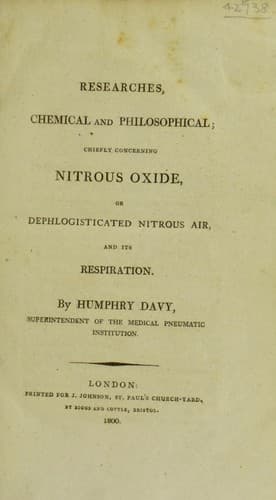
Researches Chemical and Philosophical; Chiefly concerning nitrous oxide: or dephlogisticated nitrous air and its respirationDavy, Humphry, Sir
Science
Researches Chemical and Philosophical; Chiefly concerning nitrous oxide: or dephlogisticated nitrous air and its respiration
Davy, Humphry, Sir
Nitrous oxide
These experiments did not afford approximations sufficiently accurate
towards the composition of deoxygenated acids, containing more nitrous
gas than the dark orange colored. To obtain them, a solution consisting
of 94,25 grains of blue green, or perfectly nitrated acid, (if we
may be allowed to employ the term), of specific gravity 1,475, was
inserted into a graduated phial, and connected by a curved tube, with
the mercurial airholder; in the conductor of which a small quantity of
water was inserted to absorb the nitrous acid which might be carried
over by the gas. Heat was slowly applied to the phial, and nitrous gas
given out with great rapidity. When 4 cubic inches were collected,
the acid became dark olive, when 9 dark red, when 13 bright orange,
and when 18 pale. It had lost 31 grains, and when completely cool,
was of specific gravity 1,502 nearly. The water in the apparatus was
tinged of a light blue; from whence we may conclude that some of the
nitrous gas was absorbed by it with the nitrous acid: but it will be
hereafter proved that the orange colored acid is the most nitrated acid
capable of combining undecompounded with water, and that the color it
communicates to a large quantity of water, is light blue. If then we
take 6,1 grains, the quantity of gas collected, from 31 the loss, the
remainder is 24,9, which reasoning from the synthetical experiment,
may be supposed to contain nearly 3 cubic inches of nitrous gas.
Consequently, 94,25 grains of dark green acid, of specific gravity
1,475, are composed of nearly 21 cubic inches, or 7,2 grains of nitrous
gas, and 87,05 grains of pale nitrous acid, of 1,504.
VIII. Comparing the different synthetical and analytical experiments,
we may conclude with tolerable accuracy, that 92,75 grains of bright
yellow, or standard acid of 1,5, are composed of 2,75 grains of nitrous
gas, and 90 grains of nitric acid of 1,504; but 92,75 grains of
standard acid contain 85,23 grains of nitrous acid, composed of about
27,23 of oxygene, and 58, nitrous gas: now from 58, take 2,75, and the
remainder 55,25, is the quantity of nitrous gas contained in 90 grains
of nitric acid of 1,504; consequently, 100 grains of it are composed
of 8,45 water, and 91,55 true acid, containing 61,32 nitrous gas, and
30,23 oxygene; or 27,01 nitrogene, and 64,54 oxygene: and the nitrogene
in nitric acid, is to the oxygene as 1 to 2,389.
IX. My ingenious friend, Mr. JAMES THOMSON, has communicated to me some
observations relating to the composition of nitrous acid (that is, the
orange colored acid), from which he draws a conclusion which is, in my
opinion, countenanced by all the facts we are in possession of, namely,
“that it ought not to be considered as a distinct and less oxygenated
state of acid, but simply as nitric or pale acid, holding in solution,
that is, loosely combined with, nitrous gas.”[33]
Public-domain text, read in full here on John Shaqi.
Reviews
Reviews
No reviews yet
Be the first to share your thoughts on this work.
Join the Discussion
Join the discussion
Sign in to leave a comment or review.
Sign InorCreate an account