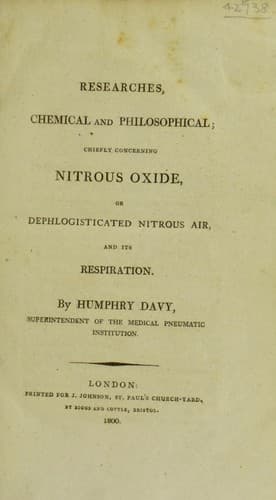
Researches Chemical and Philosophical; Chiefly concerning nitrous oxide: or dephlogisticated nitrous air and its respirationDavy, Humphry, Sir
Science
Researches Chemical and Philosophical; Chiefly concerning nitrous oxide: or dephlogisticated nitrous air and its respiration
Davy, Humphry, Sir
Nitrous oxide
[33] In a letter to me, dated Oct. 28, 1799, after giving an account
of some experiments on the phlogistication of nitric acid by heat and
light, he says, “It was from an attentive examination of the manner in
which the nitric acid was phlogisticated in these experiments, that
I was confirmed in the suspicion I had long before entertained, of
the real difference between the _nitrous_ and _nitric_ acids. It is
not enough to shew that in the _nitrous_ acid, (that is, the nitric
holding nitrous gas in solution), the proportion of oxygene in the
whole compound is less than that entering into the composition of the
nitric acid, and that it is therefore less oxygenated. By the same
mode of reasoning we might prove that water, by absorbing carbonic
acid gas, became less oxygenated, which is absurd. Should any one
attempt to prove (which will be necessary to substantiate the generally
received doctrine) that the oxygene of the nitrous gas combines with
the oxygene of the acid, and the nitrogene, in like manner, so that
the resulting acid, when nitrous gas is absorbed by nitric acid, is a
binary combination of oxygene and nitrogene, he would find it somewhat
more difficult than he at first imagined; it appears to me impossible.
It is much more consonant with experiment to suppose that nitrous acid
is nothing more than nitric acid holding nitrous gas in solution, which
might in conformity to the principles of the French nomenclature, be
called nitrate of nitrogene. The difficulty, and in some cases the
impossibility, of forming nitrites, arises from the weak affinity
which nitrous gas has for nitric acid, compared with that of other
substances; and the decomposition of nitrous acid (that is, nitrate of
nitrogene) by an alkaline or metallic substance, is perfectly analogous
to the decomposition of any other nitrate, the nitrous gas being
displaced by the superior affinity of the alkali for the acid.
“Agreeable to this theory, the salts denominated _nitrites_ are in fact
triple salts, or ternary combinations of nitric acid, nitrous gas, and
salifiable bases.”
This theory is perfectly new to me. Other Chemists to whom I have
mentioned it, have likewise considered it as new. Yet in a subsequent
letter Mr. Thomson mentions that he had been told of the belief of a
similar opinion among the French Chemists.
Public-domain text, read in full here on John Shaqi.
Reviews
Reviews
No reviews yet
Be the first to share your thoughts on this work.
Join the Discussion
Join the discussion
Sign in to leave a comment or review.
Sign InorCreate an account