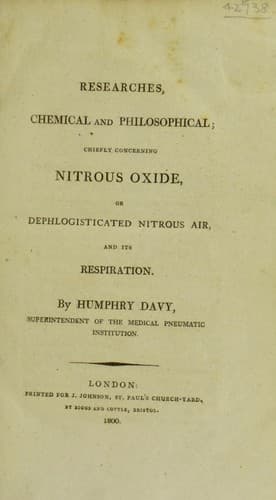
Researches Chemical and Philosophical; Chiefly concerning nitrous oxide: or dephlogisticated nitrous air and its respirationDavy, Humphry, Sir
Science
Researches Chemical and Philosophical; Chiefly concerning nitrous oxide: or dephlogisticated nitrous air and its respiration
Davy, Humphry, Sir
Nitrous oxide
It is impossible to call any substance a simple acid that is incapable
of entering undecompounded into combination with the alkalies, &c; but
it will appear hereafter that the salts called in the new nomenclature
_nitrites_, cannot be directly formed. If, indeed, it could be proved,
that the heat produced by the combination of nitrous acid with
salifiable bases, was the only cause of the partial decomposition of
it, and that when this process was effected in such a way as to prevent
increase of temperature, no nitrous gas was liberated, the common
theory might have some foundation; but though dilute phlogisticated
nitrous acid combines[34] with alkaline solutions without
decomposition, yet no excess of nitrous gas is found in the solid salt:
it is either disengaged in proportion as the water is evaporated, or it
absorbs oxygene from the atmosphere, and becomes nitric acid.
[34] In some experiments made on the nitrites of potash, and of
ammoniac, before I was well acquainted with the composition of nitric
acid, I found that a light olive-colored acid of 1,28, was capable
of being saturated by weak solutions of potash and ammoniac, without
losing any nitrous gas; but after the evaporation of the neutralised
solution, at very low temperatures, the salts in all their properties
resembled _nitrates_.
In proportion as the nitrous acids contain more nitrous gas, so in
proportion do they more readily give it out. From the blue green acid
it is liberated slowly at the temperature of 50°, and from the green
likewise on agitation. The orange coloured and yellow acids do not
require a heat above 200° to free them of their nitrous gas; and all
the colored acids, when exposed to the atmosphere absorb oxygene, and
become by degrees pale.
If the nitrous vapour, i. e. such as is disengaged during the
_denitration_ of the colored acids, was capable of combining with the
alkalies, it might be supposed a distinct acid, and called nitrous
acid; and the acids of different colors might be considered simply as
compounds of this acid with nitric acid; but it appears to be nothing
more than a solution of nitric acid in nitrous gas, incapable of
condensation, undecompounded, and when decompounded and condensed,
constituting the dark green acid, which is immiscible with water,[35]
and uncombinable with the alkalies.[36]
[35] As is evident from the curious appearance of the dark green
spherules, repulsive both to water, and light green acid.
[36] That is, undecompounded.
It seems therefore reasonable, till we are in possession of new lights
on the subject, to consider, with Mr. Thomson, the deoxygenated or
nitrous acids simply as solutions of nitrous gas composed of sulphuric
acid, metallic oxides, and nitrous gas.[37]
[37] The existence of these bodies will be hereafter proved.
Public-domain text, read in full here on John Shaqi.
Reviews
Reviews
No reviews yet
Be the first to share your thoughts on this work.
Join the Discussion
Join the discussion
Sign in to leave a comment or review.
Sign InorCreate an account