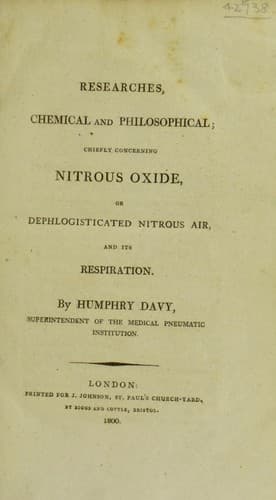
Researches Chemical and Philosophical; Chiefly concerning nitrous oxide: or dephlogisticated nitrous air and its respirationDavy, Humphry, Sir
Science
Researches Chemical and Philosophical; Chiefly concerning nitrous oxide: or dephlogisticated nitrous air and its respiration
Davy, Humphry, Sir
Nitrous oxide
Hence it would require an infinite number of experiments to ascertain
the real quantities of acid, nitrous gas, and water, contained in
the different diluted nitrous acids; and after these quantities were
determined, they would probably have no important connection with the
chemical arrangement. As yet, our instruments of experiment are not
sufficiently exact to afford us the means of ascertaining the ratio in
which the attraction of nitric acid[43] for water diminishes in its
progress towards saturation.
[43] Probably in the ratio of the square of the quantity of water
united to it.
The estimations in the following table, of the real quantities of
nitric acid in solutions of different specific gravities, were deduced
from experiments made in the manner described in section VI, except
that the phial employed was longer, narrower, and graduated to half
grains. The temperature, at the time of combination, was from 40° to
46°.
TABLE III.
_Of the Quantities of True NITRIC ACID in solutions
of different SPECIFIC GRAVITIES._
+----------------+-----+-------------+-------+
|100 Parts Nitric| |True Acid[44]| Water |
|Acid of specific| | | |
| gravity | | | |
+----------------+ +-------------+-------+
| 1,5040 | c | 91,55 | 8,45 |
| 1,4475 | o | 80,39 | 19,61 |
| 1,4285 | n | 71,65 | 28,35 |
| 1,3906 | t | 62,96 | 37,04 |
| 1,3551 | a | 56,88 | 43,12 |
| 1,3186 | i | 52,03 | 47,97 |
| 1,3042 | n | 49,04 | 50,96 |
| 1,2831 | | 46,03 | 53,97 |
| 1,2090 | | 45,27 | 54,73 |
+----------------+-----+-------------+-------+
[44] The quantities of Oxygene and Nitrogene in any solution, may be
thus found—— Let A = the true acid, X the oxygene, and Y the nitrogene.
Then
238 A A
X = —————— and Y = ————
239 239
XII. The blue green spherules mentioned in section V. produced by
the condensation of nitrous vapor, and by the combination of nitric
acid with nitrous gas, may be considered as saturated solutions of
nitrous gas in nitric acid. The combinations of nitric acid and nitrous
gas containing a larger proportion of nitrous gas, are incapable of
existing in the fluid state at common temperatures; and, as appears
from the first experiment, an increase of volume takes place during
their formation. They consequently ought to be looked upon as solutions
of nitric acid in nitrous gas, identical with the nitrous vapor of
Priestley.
Public-domain text, read in full here on John Shaqi.
Reviews
Reviews
No reviews yet
Be the first to share your thoughts on this work.
Join the Discussion
Join the discussion
Sign in to leave a comment or review.
Sign InorCreate an account