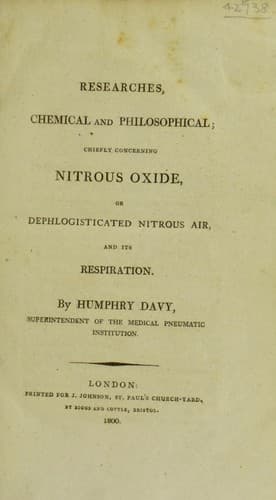
Researches Chemical and Philosophical; Chiefly concerning nitrous oxide: or dephlogisticated nitrous air and its respirationDavy, Humphry, Sir
Science
Researches Chemical and Philosophical; Chiefly concerning nitrous oxide: or dephlogisticated nitrous air and its respiration
Davy, Humphry, Sir
Nitrous oxide
From the researches of this great discoverer, we learn that nitrous
vapor is decomposable, both by water and mercury. Hence it is almost
impossible accurately to ascertain its composition. In one of his
experiments,[45] when more than 130 grains of strong nitrous acid were
exposed for two days to nearly 247 cubic inches of nitrous gas, over
water: about half of the acid was dissolved, and deposited with the gas
in the water.[46]
[45] Experiments and Observations; last edition, vol. 1, page 384.
[46] Nitrous gas, holding in solution nitrous acid, is more readily
absorbed by water than when in its pure form, from being presented to
it in a more condensed state in the green acid, formed by the contact
of water and nitrous vapor.
XIII. In comparing the results of my fundamental experiment on the
composition of nitrous acid, with those of Cavendish, the great
coincidence between them gave me very high satisfaction, as affording
additional proofs of accuracy. If the acid formed in the last
experiment of this illustrious philosopher be supposed analogous to the
light green acid formed in my first experiment, our estimations will be
almost identical.
Lavoisier’s account of the composition of the nitric and nitrous
acids, has been generally adopted. According to his estimation, these
substances contain a much larger quantity of oxygene than I have
assigned to them.
The fundamental experiments of this great philosopher were made at an
early period of pneumatic chemistry,[47] on the decomposition of nitre
by charcoal; and he considered the nitrogene evolved, and the oxygene
of the carbonic acid produced in this process, as the component parts
of the nitric acid contained in the nitre.
[47] Mem. des Savans Etrangers, v. xi. 226. Vide Kirwan sur le
phlogistique pag. 110.
I have before mentioned the liberation of nitrous acid, in the
decomposition of nitre by combustible bodies; and I had reasons for
suspecting that this circumstance was not the only source of inaccuracy.
That my suspicions were well founded, will appear from the following
experiments:
EXPERIMENT _a_. I introduced into a strong glass tube, 3 inches long,
and nearly,3 wide, a mixture of 10 grains of pulverised, well burnt
charcoal, and 60 grains of nitre. It was fired by means of touch-paper,
and the tube instantly plunged under a jar filled with dry mercury.
A quantity of gas, clouded with dense white vapor was collected.
When this vapor was precipitated, so that the surface of the mercury
could be seen, it appeared white, as if acted on by nitrous acid. On
introducing a little oxygene into the jar, copious red fumes appeared.
EXP. _b_. A similar mixture was fired[48] under the jar, the top of
the mercury being covered with a small quantity of red cabbage juice,
rendered green by an alkali. This juice, examined when the vapor
was precipitated, was become red, and on introducing to it a little
carbonate of potash, a slight effervescence took place.
Public-domain text, read in full here on John Shaqi.
Reviews
Reviews
No reviews yet
Be the first to share your thoughts on this work.
Join the Discussion
Join the discussion
Sign in to leave a comment or review.
Sign InorCreate an account