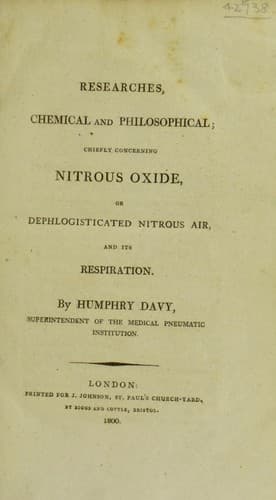
Researches Chemical and Philosophical; Chiefly concerning nitrous oxide: or dephlogisticated nitrous air and its respirationDavy, Humphry, Sir
Science
Researches Chemical and Philosophical; Chiefly concerning nitrous oxide: or dephlogisticated nitrous air and its respiration
Davy, Humphry, Sir
Nitrous oxide
[48] In this experiment, as well as in the last, some of the mixture
was thrown into the jar undecompounded.
EXP. _c_. Five grains of charcoal, and 20 of nitre, were now fired in
the same manner as before, the mercury being covered with a stratum
of water. After the precipitation of the vapor on the introduction of
oxygene, no red fumes were perceived.
EXP. _d_. 30 grains of nitre, 5 of charcoal, and five of silicious
earth,[49] were now mingled and fired. The gas received under mercury
was composed of 18 carbonic acid, and nearly 12 nitrogene.[50] A
little muriatic acid was poured on the residuum in the tube; a slight
effervescence took place.
[49] To detach the potash from the carbonic acid.
[50] This nitrogene contained a little nitrous gas, as it gave red
fumes when exposed to the air. The free nitrous acid was decomposed by
the mercury, as it was not covered with water.
EXP. _e_. The top of the mercury in the jar was now covered with a
little diluted muriatic acid, and a small glass tube filled with a
mixture of 3 grains of charcoal, and 20 nitre. After the deflagration,
the tube itself with the residuum it contained, were thrown into the
jar. The carbonic acid was quickly detached from them by the muriatic
acid, and the whole quantity of gas generated in the process, obtained;
it measured 15 cubic inches.
4 cubic inches of it exposed to solution of potash, diminished to
1⁴/₁₀; 7 of the remainder, with 8 of oxygene, gave only 12.
EXP. _f_. 60 grains of nitre, and 9 of charcoal were fired, the
top of the mercury in the jar being covered with water. After the
deflagration, the tube that had contained them was introduced, and
the carbonic acid contained by the carbonate of potash, disengaged by
muriatic acid. 30 measures of the gases evolved were exposed to caustic
potash; 20 exactly were absorbed, the 10 remaining, with 10 of oxygene,
diminished to 17.
EXP. _g_. A mixture of nitre and charcoal were deflagrated over a
little water in the mercurial jar: after the precipitation of the
vapor, the water was absorbed by filtrating paper. This filtrating
paper, heated in a solution of potash, gave a faint smell of ammoniac.
EXP. _h_. Water impregnated with the vapor produced in the
deflagration, was heated with quicklime, and presented separately to
three persons accustomed to chemical odors. Two of them instantly
recognised the ammoniacal smell, the other could not ascertain it.
Paper reddened with cabbage juice was quickly turned green by the vapor.
These experiments are sufficient to shew that the decomposition of
nitre by charcoal is a very complex process, and that the intense
degree of heat produced may effect changes in the substances employed,
which we are unable to estimate.
Public-domain text, read in full here on John Shaqi.
Reviews
Reviews
No reviews yet
Be the first to share your thoughts on this work.
Join the Discussion
Join the discussion
Sign in to leave a comment or review.
Sign InorCreate an account