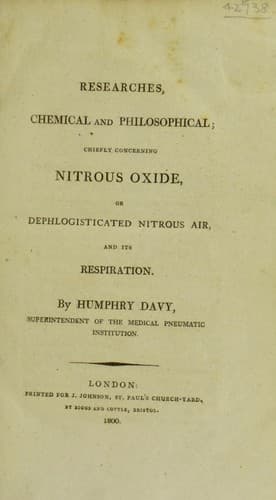
Researches Chemical and Philosophical; Chiefly concerning nitrous oxide: or dephlogisticated nitrous air and its respiration — John Shaqi
Researches Chemical and Philosophical; Chiefly concerning nitrous oxide: or dephlogisticated nitrous air and its respirationDavy, Humphry, Sir
Science
Researches Chemical and Philosophical; Chiefly concerning nitrous oxide: or dephlogisticated nitrous air and its respiration
Davy, Humphry, Sir
Nitrous oxide
100 grains of diluted sulphuric acid were introduced into the small
graduated cylinder, which after being carefully weighed, was made to
communicate with the airholder, the curved tube containing a small
quantity of water. The gas was slowly passed into the fluid, and the
globules wholly absorbed before they reached the top; much increase of
temperature being consequent. When the absorption was compleat, the
phial was increased in weight exactly 9 grains.
This experiment was repeated three times. The difference of weight,
which was probably connected with alterations of temperature and
pressure, never amounted to more than one sixth of a grain.
We may then conclude, that at temperature 58°, and atmospheric pressure
29,6, 100 cubic inches of ammoniac weigh 18 grains.
According to Kirwan, 100 cubic inches of alkaline air[67] weigh 18,16
grains; barometer 30°, thermometer 61. The difference between these
estimations, the corrections for temperature and pressure being made,
is trifling.
[67] Additional Observations, page 107.
III. _Of the quantities of true Ammoniac in Aqueous Ammoniacal
Solutions, of different specific gravities._
To ascertain the quantities of ammoniac, such as exists in the aëriform
state, saturated with moisture, in solutions of different specific
gravities, I employed the apparatus for absorption so often mentioned.
Thermometer being 52°, the mercurial airholder was filled with
ammoniacal gas, and the graduated phial, containing 50 grains of pure
water, connected with it. During the absorption of the gas, the phial
became warm. When about 30 cubic inches had been passed through, it was
suffered to cool, and weighed: it had gained 5,25 grains, and the fluid
filled a space equal to that occupied by 57[68] grains of water.
[68] It is necessary in these experiments, that the greatest care be
observed in the introduction and extraction of the capillary tube. If
it is introduced dry, there will be a source of error from the moisture
adhering to it when taken out. I therefore always wetted it before its
introduction, and took care that no more fluid adhered to it after the
experiment, than before.
Consequently, 100 grains of solution of ammoniac in water of specific
gravity,9684 contain 9,502 grains of ammoniac.
The apparatus being adjusted as before, 50 grains of pure water were
now perfectly saturated with ammoniac. They gained in weight 17
grains, and when perfectly cool, filled a space equal to 74 of water.
Consequently 100 grains of aqueous ammonial solution of specific
gravity,9054 contain 25,37 grams of ammoniac.
The two solutions were mingled together; but no alteration of
temperature took place. Consequently the resulting specific gravity
might have been found by calculation.
Public-domain text, read in full here on John Shaqi.
Reviews
Reviews
No reviews yet
Be the first to share your thoughts on this work.
Join the Discussion
Join the discussion
Sign in to leave a comment or review.
Sign InorCreate an account