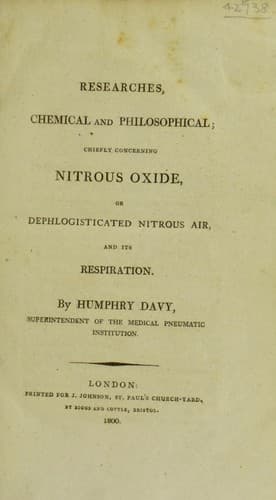
Researches Chemical and Philosophical; Chiefly concerning nitrous oxide: or dephlogisticated nitrous air and its respirationDavy, Humphry, Sir
Science
Researches Chemical and Philosophical; Chiefly concerning nitrous oxide: or dephlogisticated nitrous air and its respiration
Davy, Humphry, Sir
Nitrous oxide
_bc_
and _x_ = —————
_d_
Which, added to the quantity of the lower specific gravity, is the
alkali sought.
The differences in specific gravity of the solutions of ammoniac at
temperatures between 4O° and 65°[70] are so trifling as to be hardly
ascertainable, by our imperfect instruments, and consequently are
unworthy of notice.
[70] The expansion from increase of temperature is probably great in
proportion to the quantity of ammoniac in the solution.
It is possible at very low temperatures to obtain ammoniacal solutions
of less specific gravity than,9, but they are incapable of being kept
for any length of time under the common pressure of the atmosphere.
IV. _Combinations of Ammoniac with Nitric Acid, Composition of Nitrate
of Ammoniac, &c._
200 grains of ammoniacal solution, of specific gravity,9056, were
saturated by 385,5 grains of nitric acid, of specific gravity 1,306.
The combination was effected in a long phial, the nitrous acid added
very slowly, and the phial closed after every addition, to prevent any
evaporation in consequence of the great increase of temperature.[71]
The specific gravity of the solution, when reduced to the common
temperature, was 1,15. Evaporated at a heat of 212°,[72] it gave 254
grains of salt of fibrous crystalization. This salt was dissolved in
331 grains of water; the specific gravity of the solution was 1,148
nearly.
[71] From the combination.
[72] I had before proved that at this temperature the salt neither
decomposed nor sublimed.
Hence it was evident that some of the salt had been lost during the
evaporation.
To find the quantity lost, fibrous nitrate of ammoniac was dissolved
in small quantities in the solution, the specific gravity of which was
examined after every addition of 3 grains. When 16 grains had been
added to it, it became of 1,15.
Consequently, the solution composed of 200 grains of ammoniacal, and
of 385,5 of nitric acid solution, contained 262 grains of salt of
fibrous crystalization, and of this salt 8 grains were lost during the
evaporation.
But the alkali in 200 grains of ammoniacal solution of,9056 = 50,5
grains. And the true nitric acid in 385,5 grains of solution of 1,306 =
190 grains.
Then 262-240,5 = 21,5, the quantity of water.
And 262 grains of fibrous crystalized nitrate of ammoniac, contain 190
grains true acid, 50,5 ammoniac, and 21,5 water. And 100 parts contain
72,5 acid. 19,3 ammoniac, and 8,2 water.
In proportion as the temperature employed for the evaporation of
nitro-ammoniacal solutions, is above or below 212°, so in proportion
does the salt produced contain more or less water than the fibrous
nitrate. But whatever may have been the temperature of evaporation, the
acid and alkali appear always to be in the same proportions to each
other.
Public-domain text, read in full here on John Shaqi.
Reviews
Reviews
No reviews yet
Be the first to share your thoughts on this work.
Join the Discussion
Join the discussion
Sign in to leave a comment or review.
Sign InorCreate an account