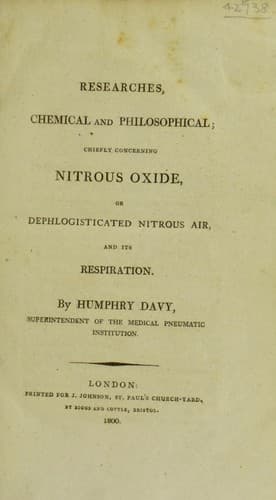
Researches Chemical and Philosophical; Chiefly concerning nitrous oxide: or dephlogisticated nitrous air and its respirationDavy, Humphry, Sir
Science
Researches Chemical and Philosophical; Chiefly concerning nitrous oxide: or dephlogisticated nitrous air and its respiration
Davy, Humphry, Sir
Nitrous oxide
Of the salts containing different quantities of water, two varieties
must be particularly noticed. The prismatic nitrate of ammoniac,
produced at the common temperatures of the atmosphere, and containing
its full quantity of water of crystalisation; and the compact nitrate
of ammoniac, either amorphous, or composed of delicately needled
crystals, formed at 300°, and containing but little more water than
exists in nitric acid and ammoniac.
To discover the composition of the prismatic nitrate of ammoniac, 200
grains of fibrous salt were dissolved in the smallest possible quantity
of water, and evaporated in a temperature not exceeding 70°. The
greater part of the salt was composed of perfectly formed tetrahædral
prisms, terminated by tetrahædral pyramids. It had gained in weight
about 8,5 grains.
Consequently 100 grains of prismatic nitrate of ammoniac may be
supposed to contain 69,5 acid, 18,4 ammoniac, and 12,1 water.
To ascertain the composition of the compact nitrate of ammoniac, I
exposed in a deep porcelain cup, 400 grains of the fibrous salt, in a
temperature below 300°. It quickly became fluid, and slowly gave out
its water without any ebullition, or liberation of gas. When it was
become perfectly dry, it had lost 33 grains. I suspected, that in this
experiment some of the salt had been carried off with the water; to
determine this, I introduced into a small glass retort, 460 grains of
fibrous salt; it was kept at a heat below 320°, in communication with a
mercurial apparatus, in a regulated air-furnace, till it was perfectly
dry: it had lost 23 grains. No gas, except the common air of the retort
came over, and the fluid collected had but a faint taste of nitrate of
ammoniac.
Though in this experiment I had removed all the fluid retained in the
neck of the retort, still a few drops remained in the head, and on
the sides, which I could not obtain. It was of importance to me to be
accurately acquainted with the composition of the compact salt, and for
that reason I compared these analytical experiments with a synthetical
one.
I saturated 200 grains of solution of ammoniac, of,9056 with acid,
ascertained the specific gravity of the solution, evaporated it at
212°, and fused and dried it at about 300°-260°. It gave 246 grains
of salt, and a solution made of the same specific gravity as that
evaporated, indicated a loss of 9 grains. Consequently, 255 grains of
this salt contain 50,5 grains alkali, 100 grains acid, and 14,5 grains
water.
We may then conclude, that 100 parts of compact nitrate of ammoniac
contain 74,5 acid, 19,8 alkali, and 5,7 water.
V. _Decomposition of Carbonate of Ammoniac by Nitric Acid._
Public-domain text, read in full here on John Shaqi.
Reviews
Reviews
No reviews yet
Be the first to share your thoughts on this work.
Join the Discussion
Join the discussion
Sign in to leave a comment or review.
Sign InorCreate an account