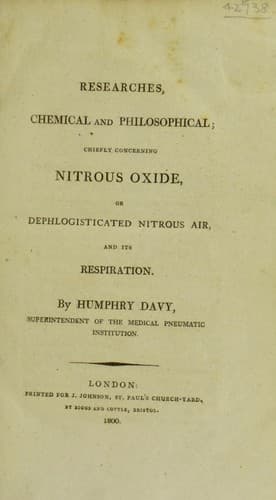
Researches Chemical and Philosophical; Chiefly concerning nitrous oxide: or dephlogisticated nitrous air and its respirationDavy, Humphry, Sir
Science
Researches Chemical and Philosophical; Chiefly concerning nitrous oxide: or dephlogisticated nitrous air and its respiration
Davy, Humphry, Sir
Nitrous oxide
In my first experiments on the production of nitrate of ammoniac, I
endeavoured to ascertain its composition by decompounding carbonate
of ammoniac by nitric acid; and in making for this purpose, the
analysis of carbonate of ammoniac, I discovered that there existed
many varieties of this salt, containing very different proportions of
carbonic acid, alkali, and water; the carbonic acid and water being
superabundant in it, in proportion as the temperature of its formation
was low, and the alkali in proportion as it was high: and not only
that a different salt was formed at every different temperature, but
likewise that the difference in them was so great, that the carbonate
of ammoniac formed at 300° contained more than 50 per cent alkali,
whilst that produced at 60° contained only 20.[73]
I found 210 grains of carbonate of ammoniac, which from comparison with
other salts previously analised, I suspected to contain about 20 or
21 per cent alkali, saturated by 200 grains of nitric acid of 1,504.
But though the carbonate was dissolved in much water, still, from the
smell of the carbonic acid generated, I suspect that a small portion
of the nitric acid was dissolved, and carried off by it. The solution,
evaporated at about 200°, and afterwards exposed to a temperature below
300°, gave 232 grains of compact salt. But reasoning from the quantity
of acid in 200 grains of nitric acid of 1,504, it ought to have given
245. Consequently 13 were lost by evaporation; and this loss agrees
with that in the other experiments.
[73] A particular account of the experiments from which these facts
were deduced, was printed in September, and will appear in the first
volume of the _Researches_.
VI. _Decomposition of Sulphate of Ammoniac by Nitre._
As a cheap mode of obtaining nitrate of ammoniac, Dr. BEDDOES proposed
to decompose nitre by sulphate of ammoniac, which is a well known
article of commerce. From synthesis of sulphate of ammoniac, compared
with analysis made in August 1799,[74] I concluded that 100 grains of
prismatic salt were composed of about 18 grains ammoniac, 44 acid, and
38 water; and supposing 100 grains of nitre to contain 50 acid, 100
grains of sulphate of ammoniac will require for their decomposition 134
grains of nitre, and form 90,9 grains of compact nitrate of ammoniac.
[74] And which will be published, with an account of its perfect
decomposition at a high temperature, in the _Researches_.
Public-domain text, read in full here on John Shaqi.
Reviews
Reviews
No reviews yet
Be the first to share your thoughts on this work.
Join the Discussion
Join the discussion
Sign in to leave a comment or review.
Sign InorCreate an account