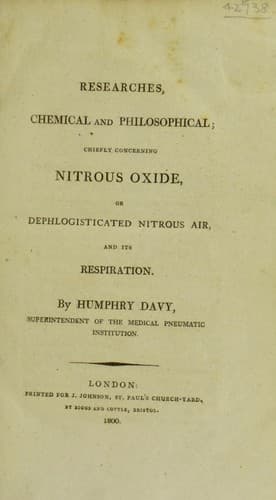
Researches Chemical and Philosophical; Chiefly concerning nitrous oxide: or dephlogisticated nitrous air and its respirationDavy, Humphry, Sir
Science
Researches Chemical and Philosophical; Chiefly concerning nitrous oxide: or dephlogisticated nitrous air and its respiration
Davy, Humphry, Sir
Nitrous oxide
To ascertain if the sulphate of potash and nitrate of ammoniac could be
easily separated, I added to a heated saturated solution of sulphate of
ammoniac, pulverised nitre, till the decomposition was complete. After
this decomposition, the solution contained a slight excess of sulphuric
acid, which was combined with lime, and the whole set to evaporate at
a temperature below 250°. As soon as the sulphate of potash began to
crystalise, the solution was suffered to cool, and then poured off from
the crystalised salt, which appeared to contain no nitrate of ammoniac.
After a second evaporation and crystalisation, almost the whole of
the sulphate appeared to be deposited, and the solution of nitrate of
ammoniac was obtained nearly pure: it was evaporated at 212°, and gave
fibrous crystals.
VII. _Non-existence of Ammoniacal Nitrites._
I attempted in different modes to combine _nitrous_ acids with
ammoniac, so as to form the salts which have been supposed to exist,
and called _nitrites_ of ammoniac; but without success.
I first decomposed a solution of carbonate of ammoniac by dilute olive
colored acid; but in this process, though no heat was generated,
yet all the nitrous gas appeared to be liberated with the carbonic
acid.[75] I then combined a small quantity of nitrous gas, with a
solution of nitrate of ammoniac. But after evaporating this solution
at 70°-80°, I could not detect the existence of nitrous gas in the
solid salt; it was given out during the evaporation and crystalisation,
and formed into nitrous acid by the oxygene of the atmosphere. I
likewise heated nitrate of ammoniac to different degrees, and partially
decomposed it, to ascertain if in any case the acid was phlogisticated
by heat: but in no experiment could I detect the existence of
_nitrous_ acid in the heated salt, when it had been previously
perfectly neutralised.
[75] When nitrous gas exists in neutro-saline solutions, they are
always colored more or less intensely, from yellow to olive, in
proportion to the quantity combined with them.
When nitrate of ammoniac, indeed, with excess of nitric acid, is
exposed to heat, the superabundant nitric acid becomes phlogisticated,
and is then liberated from the salt, which remains neutral.[76]
[76] Hence a nitrate of ammoniac with excess of acid, when exposed to
heat, first becomes yellow, and then white.
We may therefore conclude that nitrous gas has little or no affinity
for solid nitrate of ammoniac, and that no substance exists to which
the name _nitrite_ of ammoniac can with propriety be applied.
VIII. _Of the sources of error in Analysis._
To compare my synthesis of nitrate of ammoniac with analysis, I
endeavoured to separate the ammoniac and nitric acid from each other,
without decomposition. But in going through the analytical process, I
soon discovered that it was impossible to make it accurate, without
many collateral laborious experiments on the quantities of ammoniac
soluble in water at different temperatures.
Public-domain text, read in full here on John Shaqi.
Reviews
Reviews
No reviews yet
Be the first to share your thoughts on this work.
Join the Discussion
Join the discussion
Sign in to leave a comment or review.
Sign InorCreate an account