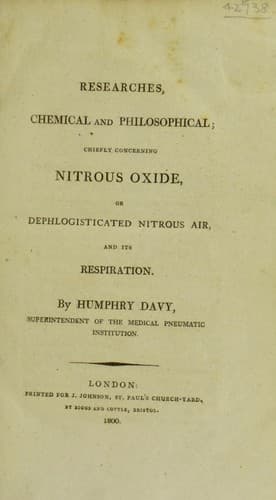
Researches Chemical and Philosophical; Chiefly concerning nitrous oxide: or dephlogisticated nitrous air and its respirationDavy, Humphry, Sir
Science
Researches Chemical and Philosophical; Chiefly concerning nitrous oxide: or dephlogisticated nitrous air and its respiration
Davy, Humphry, Sir
Nitrous oxide
At a temperature above 212°, I decomposed, by caustic slacked lime, 50
grains of compact nitrate of ammoniac in a retort communicating with
the mercurial airholder, the moisture in which had been previously
saturated with ammoniac. 22 cubic inches of gas were collected at 38°,
and from the loss of weight of the retort, it appeared that 13 grains
of solution of ammoniac in water, had been deposited by the gas.
Now evidently, this solution must have contained much more alkali in
proportion to its water than that of 55°, otherwise the quantity of
ammoniac in 50 grains of salt would hardly equal 8 grains.[77]
[77] The accounts given by different chemists of the composition of
nitrate of ammoniac, are extremely discordant; they have been chiefly
deduced from decompositions of carbonate of ammoniac (the varieties of
which have been heretofore unknown) by nitrous acids of unknown degrees
of nitration. Hence they are particularly erroneous with regard to the
alkaline part. Wenzel supposes it to be 32 per cent, and Kirwan 24.
_Addit. Observ._ pag. 120.
IX. _Of the loss of Solutions of Nitrate of Ammoniac during
evaporation._
The most concentrated solution of nitrate of ammoniac capable of
existing at 60°, is of specific gravity 1,304, and contains 33 water,
and 67 fibrous salt, per cent. When this solution is evaporated at
temperatures between 60° and 100, the salt is increased in weight by
the addition of water of crystalisation, and no portion of it is lost.
During the evaporation of solutions of specific gravity 1,146 and 1,15,
at temperatures below 120°, I have never detected any loss of salt.
When the temperature of evaporation is 212°, the loss is generally from
3 to 4 grains per cent; and when from 230° to the standard of their
ebullition, from 4 to 6 grains.
In proportion as solutions are more diluted, their loss in evaporation
at equal temperatures is greater.
DIVISION III.
_Decomposition of NITRATE of AMMONIAC: preparation of
RESPIRABLE NITROUS OXIDE; its ANALYSIS._
I. _Of the heat required for the decomposition of NITRATE of AMMONIAC._
The decomposition of nitrate of ammoniac has been supposed by
Cornette[78] to take place at temperatures below 212°, and its
sublimation at 234°.
Kirwan, from the non-coincidence in the accounts of its composition,
has imagined that it is partially decomposable, even by a heat of
80°.[79]
[78] Mem. Par. 1783. See Irish Trans. vol. 4.
[79] Addit. Obs. pag. 120.
To ascertain the changes effected by increase of temperature in this
salt, a glass retort was provided, tubulated for the purpose of
introducing the bulb of a thermometer. After it had been made to
communicate with the mercurial airholder, and placed in a furnace,
the heat of which could be easily regulated, the thermometer was
introduced, and the retort filled with the salt, and carefully luted;
so that the appearances produced by different temperatures could be
accurately observed, and the products evolved obtained.
Public-domain text, read in full here on John Shaqi.
Reviews
Reviews
No reviews yet
Be the first to share your thoughts on this work.
Join the Discussion
Join the discussion
Sign in to leave a comment or review.
Sign InorCreate an account