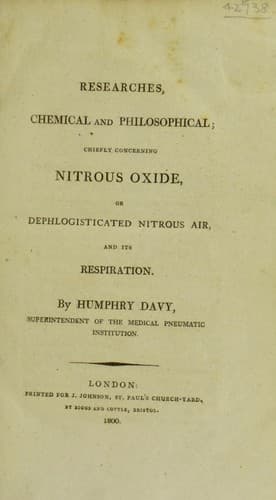
Researches Chemical and Philosophical; Chiefly concerning nitrous oxide: or dephlogisticated nitrous air and its respiration — John Shaqi
Researches Chemical and Philosophical; Chiefly concerning nitrous oxide: or dephlogisticated nitrous air and its respirationDavy, Humphry, Sir
Science
Researches Chemical and Philosophical; Chiefly concerning nitrous oxide: or dephlogisticated nitrous air and its respiration
Davy, Humphry, Sir
Nitrous oxide
From a number of experiments made in this manner on different salts,
the following conclusions were drawn.
1st. Compact, or dry nitrate of ammoniac, undergoes little or no change
at temperatures below 260°.
2dly. At temperatures between 275° and 300°, it slowly sublimes,
without decomposition, or without becoming fluid.
3dly. At 320° it becomes fluid, decomposes, and still slowly sublimes;
it neither assuming, or continuing in, the fluid state, without
decomposition.
4thly. At temperatures between 340° and 480°, it decomposes rapidly.
5thly. The prismatic and fibrous nitrates of ammoniac become fluid at
temperatures below 300°, and undergo ebullition at temperatures between
360° and 400°, without decomposition.
6thly. They are capable of being heated to 430° without decomposition,
or sublimation, till a certain quantity of their water is evaporated.
7thly. At temperatures above 450° they undergo decomposition, without
previously losing their water of crystalisation.
II. _Decomposition of Nitrate of Ammoniac; production of respirable
Nitrous Oxide; its properties._
200 grains of compact nitrate of ammoniac were introduced into a
glass retort, and decomposed slowly by the heat of a spirit lamp.
The first portions of the gas that came over were rejected, and the
last received in jars containing mercury. No luminous appearance was
perceived in the retort during the process, and almost the whole of the
salt was resolved into fluid and gas. The fluid had a faint acid taste,
and contained some undecompounded nitrate. The gas collected exhibited
the following properties.—
_a._ A candle burnt in it with a brilliant flame, and crackling noise.
Before its extinction, the white inner flame became surrounded with an
exterior blue one.
_b._ Phosphorus introduced into it in a state of inflammation, burnt
with infinitely greater vividness than before.
_c._ Sulphur introduced into it when burning with a feeble blue flame,
was instantly extinguished; but when in a state of active inflammation
(that is, forming sulphuric acid) it burnt with a beautiful and vivid
rose-colored flame.
_d._ Inflamed charcoal, deprived of hydrogene, introduced into it,
burnt with much greater vividness than in the atmosphere.
_e._ To some fine twisted iron wire a small piece of cork was affixed:
this was inflamed, and the whole introduced into a jar of the air. The
iron burned with great vividness, and threw out bright sparks as in
oxygene.
_f._ 30 measures of it exposed to water previously boiled, was rapidly
absorbed; when the diminution was complete, rather more than a measure
remained.
_g._ Pure water saturated with it, gave it out again on ebullition, and
the gas thus produced retained all its former properties.
_h._ It was absorbed by red cabbage juice; but no alteration of color
took place.
_i._ Its taste was distinctly sweet, and its odor slight, but agreeable.
_j._ It underwent no diminution when mingled with oxygene or nitrous
gas.
Public-domain text, read in full here on John Shaqi.
Reviews
Reviews
No reviews yet
Be the first to share your thoughts on this work.
Join the Discussion
Join the discussion
Sign in to leave a comment or review.
Sign InorCreate an account