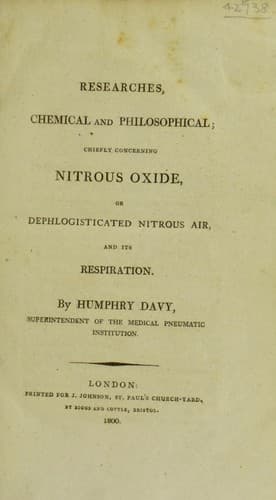
Researches Chemical and Philosophical; Chiefly concerning nitrous oxide: or dephlogisticated nitrous air and its respirationDavy, Humphry, Sir
Science
Researches Chemical and Philosophical; Chiefly concerning nitrous oxide: or dephlogisticated nitrous air and its respiration
Davy, Humphry, Sir
Nitrous oxide
Such were the obvious properties of the NITROUS OXIDE, or the gas
produced by the decomposition of nitrate of ammoniac in a temperature
not exceeding 440°. Other properties of it will be hereafter
demonstrated, and its affinities fully investigated.
III. _Of the gas remaining after the absorption of Nitrous Oxide by
Water._
In exposing nitrous oxide at different times to rain or spring water,
and water that had been lately boiled, I found that the gas remaining
after the absorption was always least when boiled water was employed,
though from the mode of production of the nitrous oxide, I had reason
to believe that its composition was generally the same.
This circumstance induced me to suppose that some of the residuum
might be gas previously contained in the water, and liberated from
it in consequence of the stronger affinity of that fluid for nitrous
oxide. But the greater part of it, I conjectured to consist of
nitrogene produced in consequence of a complete decomposition of part
of the acid, by the hydrogene. It was in endeavoring to ascertain the
relative purity of nitrous oxide produced at different periods of the
process of the decomposition of nitrate of ammoniac, that I discovered
the true reason of the appearance of residual gas.
I decomposed some pure nitrate of ammoniac in a small glass retort;
and after suffering the first portions to escape with the common air,
I caught the remainder in three separate vessels standing in the same
trough, filled with water that had been long boiled, and which at
the time of the experiment was so warm that I could scarcely bear my
hands in it. The different quantities collected gave the same intense
brilliancy to the flame of a taper.
26 measures of each of them were separately inserted into 3 graduated
cylinders, of nearly the same capacity, over the same boiled water.
As the water cooled, the gas was absorbed by agitation. When the
diminution was complete, the residuum in each cylinder filled, as
nearly as possible, the same space; about two thirds of a measure.
To each of the residuums I added two measures of nitrous gas; they gave
copious red vapor, and after the condensation filled a space rather
less than two measures.
Hence the residual gas contained more oxygene than common air.
I now introduced 26 measures of gas from one of the vessels into a
cylinder filled with unboiled spring water of the same kind.[80] After
the absorption was complete, near two measures remained. These added to
two measures of nitrous air, diminished to 2,5 nearly.
[80] Two measures of air dispelled from this water by boiling, mingled
with 2 of nitrous gas, diminished to 2,4 nearly.
These experiments induced me to believe that the residual gas was not
produced in the decomposition of nitrate of ammoniac, but that it was
wholly liberated from the water.
Public-domain text, read in full here on John Shaqi.
Reviews
Reviews
No reviews yet
Be the first to share your thoughts on this work.
Join the Discussion
Join the discussion
Sign in to leave a comment or review.
Sign InorCreate an account