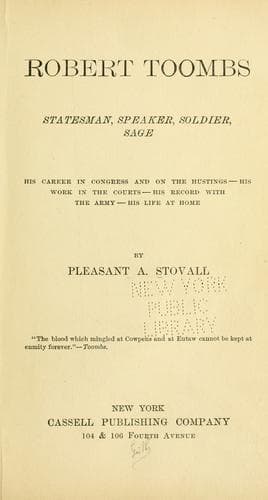
Robert Toombs: Statesman, Speaker, Soldier, SageStovall, Pleasant A.
History
Robert Toombs: Statesman, Speaker, Soldier, Sage
Stovall, Pleasant A.
Toombs, Robert Augustus, 1810-1885
He was highminded, fearless, and sincere, and it may be said
of him what he afterward declared so often of Henry Clay, that "he would
not flatter Neptune for his trident or Jove for his power to thunder."
He was called upon at this session to fight the repeal of the law he had
framed in 1840, to regulate the system of banking. He declared in
eloquent terms that the State must restrict the issue of the banks and
compel their payment in specie. The experiment of banking on public
credit had failed, he said. It had brought loss to the government,
distress to the people, and had sullied the good faith of Georgia.
It was at this session of the legislature that the Democrats proposed a
vote of censure upon John McPherson Berrien, United States Senator from
Georgia, for his advocacy of a national bank. Mr. Toombs ardently
defended Senator Berrien. He said that the State legislature was not the
custodian of a senator's conscience, and held that the people of Georgia
sanctioned the expediency and utility of a national bank. When the
resolution of censure came up in the house, the Whigs refused to vote,
and raised the point of "no quorum." Speaker _pro tem_. Wellborn, who
presided, counted a quorum and declared the resolutions adopted. Mr.
Toombs fired up at this unusual decision. He threw himself before the
Speaker with impetuous appeal and called for a reversal of the decision.
But it was a Democratic house, and the Speaker was sustained by a vote
of 96 to 40.
The craze for internal improvements now swept over the country. The
Whigs were especially active, and we find resolutions adopted by the
General Assembly, calling on the Federal Government to create ports of
entry and to build government foundries and navy yards on the Southern
seaboard. Mr. Toombs was chairman of the Committee of Internal
Improvements, but his efforts were directed toward the completion of the
Western and Atlantic Railroad. These enterprises had overshadowed the
waterways, and the railway from Charleston, S. C., to Augusta, Ga., one
of the very first in the country, had just been completed. Already a
company had embarked upon the construction of the Georgia Railroad, and
on May 21, 1837, the first locomotive ever put in motion on the soil of
Georgia moved out from Augusta. A local paper described the event in
sententious terms:
This locomotive started beautifully and majestically from
the depository and, following the impetus given, flew with
surprising velocity on the road which hereafter is to be
her natural element.
Public-domain text, read in full here on John Shaqi.
Reviews
Reviews
No reviews yet
Be the first to share your thoughts on this work.
Join the Discussion
Join the discussion
Sign in to leave a comment or review.
Sign InorCreate an account