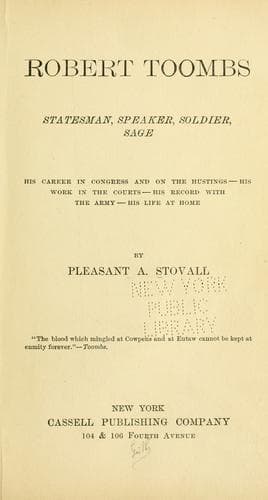
Robert Toombs: Statesman, Speaker, Soldier, SageStovall, Pleasant A.
History
Robert Toombs: Statesman, Speaker, Soldier, Sage
Stovall, Pleasant A.
Toombs, Robert Augustus, 1810-1885
The General Assembly decided that these rail lines should have an outlet
to the West. This great road was finally built and operated from Atlanta
to Chattanooga, and is still owned by the State, a monument to the
sagacity and persistency of Toombs and his associates in 1840. The great
possibilities of these iron highways opened the eyes of the statesmen
of that day, Mr. Calhoun seemed to drop for a time his philosophical
studies of States and slavery and to dream of railroads and commercial
greatness. He proposed the connection of the Atlantic Ocean with the
Mississippi River and the great West, through Cumberland Gap--a
brilliant and feasible scheme. Governor Gilmer of Georgia declared in
his message that these projected roads "would add new bonds to the
Union." But King Cotton, with his millions in serfdom, issued his
imperial decrees, and not even this great railroad development could
keep down the tremendous tragedy of the century.
One of the measures to which Mr. Toombs devoted great attention during
his legislative term was the establishment of a State Supreme Court.
This bill was several times defeated, but finally in 1843 passed the
house by a vote of 88 to 86. It was the scene of many of his forensic
triumphs. He also introduced, during the sessions of 1842 and 1843,
bills to abolish suretyship in Georgia. This system had been severely
abused. In the flush times men indorsed without stint, and then during
the panic of 1837 "reaped the whirlwind." Fortunes were swept away,
individual credit ruined, and families brought to beggary by this
reckless system of surety. What a man seldom refused to do for another,
Mr. Toombs strove to reach by law. But the system had become too firmly
intrenched in the financial habits of the people. His bill, which he
distinctly stated was to apply alone to future and not past contracts,
only commanded a small minority of votes. It was looked upon as an
abridgment of personal liberty. Mr. Toombs exerted all of his efforts in
behalf of this bill, and it became quite an issue in Georgia. It is not
a little strange that when Robert Toombs was dead, it was found that his
own estate was involved by a series of indorsements which he had given
in Atlanta to the Kimball House Company. Had he maintained the activity
of his younger days, he would probably have turned this deal into a
profitable investment. The complication was finally arranged, but his
large property came near being swept away under the same system of
surety he had striven to abolish.
CHAPTER IV.
ELECTED TO CONGRESS.
Public-domain text, read in full here on John Shaqi.
Reviews
Reviews
No reviews yet
Be the first to share your thoughts on this work.
Join the Discussion
Join the discussion
Sign in to leave a comment or review.
Sign InorCreate an account