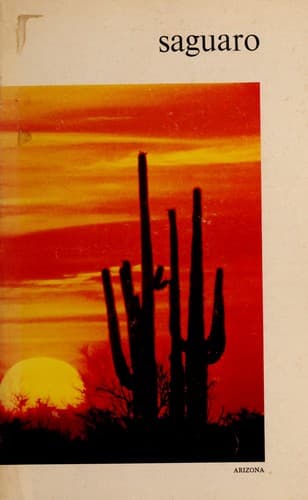
Desert ecology -- Arizona -- Saguaro National Park; Natural history -- Arizona -- Saguaro National Park
One of the common trees in the desert part of the monument is the
MESQUITE (mess-KEET). In general appearance it resembles a small, spiny
apple or peach tree with finely divided leaves. Its roots sometimes
penetrate to a depth of 40 or more feet, thus securing moisture at the
deeper, cooler soil levels, from a supply that remains nearly constant
throughout the year. This enables the tree to expose a rather large
expanse of leaf surface without losing more water than it can replace. A
number of mechanical devices help the tree reduce its water loss during
the driest part of the day (10 a.m. to 4 p.m.). Among these are its
ability to fold its leaves and close the stomata (breathing pores),
thereby greatly reducing the surface area exposed to exhaling and
evaporating influences. In April and May, mesquite trees are covered
with pale-yellow, catkinlike flowers which attract swarms of insects.
These flowers develop to stringbeanlike pods rich in sugar and important
as food for deer and other animals. In earlier days, the mesquite was
also a valuable source of food and firewood for Indians and pioneers.
[Illustration: Pricklypear blossom.]
[Illustration: Claret cup hedgehog.]
[Illustration: Fishhook cactus.]
[Illustration: Cholla in bloom.]
[Illustration: Staghorn cholla.]
Another desert tree abundant in the monument is the YELLOW PALOVERDE. It
is somewhat similar in size and general shape to the mesquite. Lacking
the deeply penetrating root system of the mesquite, the paloverde
(Spanish word meaning “green stick”) has no dependable moisture source;
but it has made unusual adaptations that enable it to retain as much as
possible of the water collected by its roots. In early spring the tree
leafs out in dense foliage, which is followed closely by a blanket of
yellow blossoms. At this season the paloverdes provide one of the most
spectacular displays of the desert, particularly along washes, where
they grow especially well. Blue paloverde, growing in the arroyos,
blooms well every year. Yellow, or foothill, paloverde, a separate
species, blooms only if the soil moisture is high following winter
rains.
With the coming of the hot, drying weather of late spring, the trees
need to reduce their moisture losses. They gradually drop their leaves
until, by early summer, each tree has become practically bare. The trees
do not enter a period of dormancy, but are able to remain active because
their green bark contains chlorophyll. Thus, the bark takes over some of
the food-manufacturing function normally performed by leaves, but
without the high rate of water loss.
Public-domain text, read in full here on John Shaqi.
Reviews
Reviews
No reviews yet
Be the first to share your thoughts on this work.
Join the Discussion
Join the discussion
Sign in to leave a comment or review.
Sign InorCreate an account