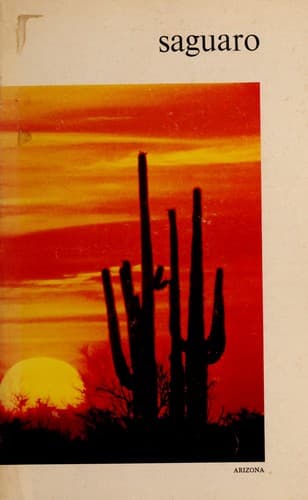
Desert ecology -- Arizona -- Saguaro National Park; Natural history -- Arizona -- Saguaro National Park
Carrying the drought-evasion habits of the paloverde a step further, the
OCOTILLO (oh-koh-TEE-yoh) comes into full leaf following each rainy
spell during the warmer months. During the intervening dry periods it
sheds its foliage. The ocotillo, a common and conspicuous desert
dweller, is a shrub of striking appearance, with thorny, whiplike,
unbranching stems 8 to 12 feet long growing upward in a funnel-shaped
cluster. In spring, showy scarlet flower clusters appear at the tips of
the stems, making each plant a glowing splash of color.
[Illustration: Mesquite in bloom.]
A number of desert shrubs fail to display as much ingenuity as the
paloverde. Some of these evade the dry season simply by going into a
state of dormancy. The WOLFBERRY bursts into full leaf soon after the
first winter rains and blossoms as early as January. Its small,
tomato-red, juicy fruits are sought by birds, which also find protective
cover for their nests and for overnight perches in the stiff, thorny
shrubs. In the past, the berrylike fruits were important to the Indians,
who ate them raw or made them into a sauce.
[Illustration: Yellow paloverde, Tucson Mountain Section.]
Commonest of the conspicuous desert non-succulent shrubs is the
wispy-looking but tough CREOSOTEBUSH, found principally on poor soils
and on the desert flats between mountain ranges. It is also sprinkled
throughout the paloverde-saguaro community in the monument. A new crop
of wax-coated, musty-smelling leaves, giving the plant the local (but
mistaken) name “grease-wood,” appears as early as January. The leaves
are followed by a profuse blooming of small yellow flowers and cottony
seed balls. During abnormally moist summers or in damp locations, the
leaves and flowers persist the year round; but usually the coming of dry
weather brings an end to the blossoming period. If the dry spell is
exceptionally long, the leaves turn brown, and the plants remain dormant
until awakened by the next winter’s rainfall. Pima Indians formerly
gathered a resinous material, known as lac, which accumulates on the
bark of its branches, and used it to mend pottery and fasten arrow
points. They also steeped the leaves to obtain an antiseptic medicine.
Ground squirrels commonly feed on the seeds.
[Illustration: Ironwood blossoms.]
[Illustration: Parry’s penstemon.]
A large shrub of open, sprawling growth usually found along desert
washes in company with mesquite is CATCLAW. Its name refers to the small
curved thorns that hide on its branches. In April and May, the small
trees are covered with fragrant, pale-yellow, catkinlike flower clusters
that attract swarms of insects. The seed pods were ground into meal by
the Indians and eaten as mush and cakes.
Public-domain text, read in full here on John Shaqi.
Reviews
Reviews
No reviews yet
Be the first to share your thoughts on this work.
Join the Discussion
Join the discussion
Sign in to leave a comment or review.
Sign InorCreate an account