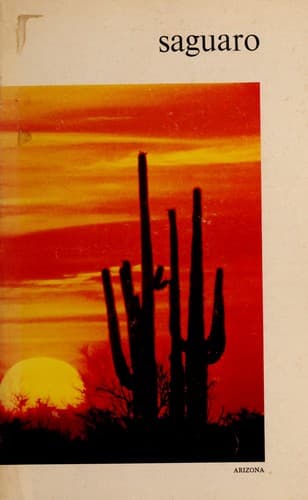
Desert ecology -- Arizona -- Saguaro National Park; Natural history -- Arizona -- Saguaro National Park
In lower elevations of the Tucson Mountain Section, the gray-blue
foliage of IRONWOOD is a common sight, but the species does not range
farther eastward. Its wisterialike lavender-and-white flowers blossom in
May and June. The nutritious seeds are harvested by rodents and formerly
were parched and eaten by Indians. The wood is so dense that it sinks in
water; Indians used it for making arrowheads and tool handles.
Ferns—commonly, plants of dank woods and other moist habitats—seem
entirely out of place in the desert; nevertheless, some members of the
fern family have overcome drought conditions. The GOLDFERN is common on
rocky ledges, where it persists by means of special drought-resistant
cells.
Among the smaller perennials are many that add to spring flower displays
when conditions of moisture and temperature are favorable. Perennials do
not need to mature their seeds before the coming of summer as do the
ephemerals; a majority start blossoming somewhat later in the spring,
and gaily flaunt their flowers long after the annuals have faded and
died. When the heat and drought of early summer begin to bear down, they
gradually die back, surviving the “long dry” by their persistent roots
and larger stems. One of the most noticeable and beautiful of this group
of small perennials fairly common in the monument is PARRY’S PENSTEMON.
It occurs in scattered clumps on well-drained slopes along the base of
Tanque Verde Ridge. The showy rose-magenta flowers and the glossy-green
leaves arise from erect stems that may grow 4 feet tall in favorable
seasons.
Among the first of the shrubby perennials to cover the rocky hillsides
with a blanket of winter and springtime bloom is the BRITTLEBUSH. Masses
of yellow sunflowerlike blossoms are borne on long stems that exude a
gum which was chewed by the Indians and was also burned as incense in
early mission churches.
A conspicuous perennial that survives the dry season as an underground
bulb is BLUEDICKS. Although it doesn’t occur in massed bloom, it does
add spots of color to the desert scene. Usually appearing from February
to May, bluedicks has violet flower clusters on long, slender, erect
stems. The bulbs were dug and eaten by Pima and Papago Indians.
Although neither conspicuous nor attractive, the common TRIANGLE BURSAGE
is an important part of the paloverde-saguaro community in the Tucson
Mountains. A low, rounded, white-barked shrub, bursage has small,
colorless flowers without petals. (Being wind-pollinated, the flowers do
not need to attract insects.)
Public-domain text, read in full here on John Shaqi.
Reviews
Reviews
No reviews yet
Be the first to share your thoughts on this work.
Join the Discussion
Join the discussion
Sign in to leave a comment or review.
Sign InorCreate an account