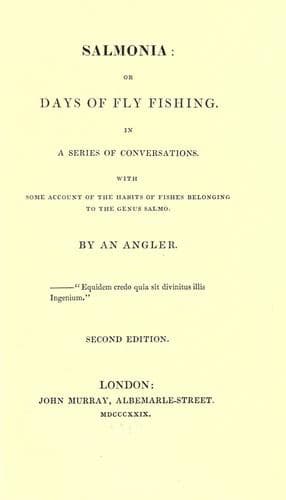
Salmonia; Or, Days of Fly Fishing: In a series of conversations. With some account of the habits of fishes belonging to the genus Salmo — John Shaqi
Salmonia; Or, Days of Fly Fishing: In a series of conversations. With some account of the habits of fishes belonging to the genus SalmoDavy, Humphry, Sir
Philosophy
Salmonia; Or, Days of Fly Fishing: In a series of conversations. With some account of the habits of fishes belonging to the genus Salmo
Davy, Humphry, Sir
Fishing
browns, particularly when the water was a little stained after a small
flood, afforded the angler good sport. In Herefordshire and Derbyshire,
where trout and grayling are often found together, the same periods are
generally best for angling; but in the Dove, Lathkill, and Wye, with the
natural May-fly, many fish may be taken; and in old times, in peculiarly
windy days, or high and troubled water, even the artificial May-fly,
according to Cotton, was very killing.
POIET.—I have heard various accounts of the excellent fishing in some of
the great lakes in Ireland. Can you tell us any thing on the subject,
and if the same flies may be used in that island?
HAL.—I have been several times in Ireland, but never at this season,
which is considered as best for lake-fishing. I have heard that in some
of the lakes in Westmeath, very large trout, and great quantities may be
taken in the beginning of June, with the very flies we have been using
this day. Wind is necessary; and a good angler sometimes takes in a day,
or rather formerly took, from ten to twelve fish, which weighed from 3
to 10lbs., and which occasionally were even larger. In the summer after
June, and in the autumn, the only seasons when I have fished in Ireland,
I have seldom taken any large trout; but in the river Boyle, late in
October, after a flood, I once had some sport with these fish, that were
running up the river from Lock Key to spawn. I caught one day two above
3lbs. that took a large reddish-brown fly of the same kind as a salmon
fly; and I saw some taken that weighed 5lbs., and heard of one that
equalled 9lbs. These fish were in good season, even at this late period,
and had no spots, but were coloured red and brown—mottled like
tortoise-shell, only with smaller bars. I have in July, likewise, fished
in Loch Con, near Ballina, and Loch Melvin, near Ballyshannon. In Loch
Con, the party caught many small good trout, that cut red; and in the
other I caught a very few trout only, but as many of them were gillaroo
or gizzard trout as common trout.
POIET.—This must have been an interesting kind of fishing. In what does
the gillaroo differ from the trout?
HAL.—In appearance very little, except that they have more red spots,
and a yellow or golden-coloured belly and fins, and are generally a
broader and thicker fish; but internally they have a different
organization, possessing a large thick muscular stomach, which has been
improperly compared to a fowl’s, and which generally contains a quantity
of small shell-fish of three or four kinds: and though in those I caught
the stomachs were full of these shell-fish, yet they rose greedily at
the fly.
POIET.—Are they not common trout which have gained the habit of feeding
on shell-fish?
Public-domain text, read in full here on John Shaqi.
Reviews
Reviews
No reviews yet
Be the first to share your thoughts on this work.
Join the Discussion
Join the discussion
Sign in to leave a comment or review.
Sign InorCreate an account