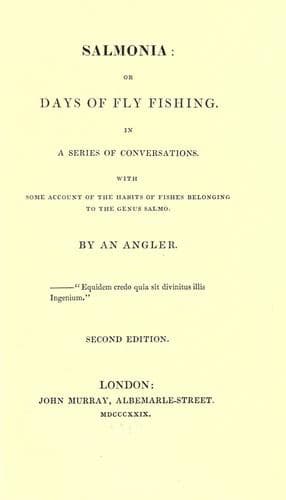
Salmonia; Or, Days of Fly Fishing: In a series of conversations. With some account of the habits of fishes belonging to the genus SalmoDavy, Humphry, Sir
Philosophy
Salmonia; Or, Days of Fly Fishing: In a series of conversations. With some account of the habits of fishes belonging to the genus Salmo
Davy, Humphry, Sir
Fishing
HAL.—If so, they have been altered in a succession of generations. The
common trouts of this lake have stomachs like other trouts, which never,
as far as my experience has gone, contain shell-fish; but of the
gillaroo trout, I have caught with a fly some not longer than my finger,
which have had as perfect a hard stomach as the larger ones, with the
coats as thick in proportion, and the same shells within; so that this
animal is at least _now_ a distinct species, and is a sort of link
between the trout and char, which has a stomach of the same kind with
the gillaroo, but not quite so thick, and which feeds at the bottom in
the same way. I have often looked in the lakes abroad for gillaroo
trout, and never found one. In a small lake at the foot of the Crest of
the Brenner, above 4000 feet above the level of the sea, I once caught
some trout, which, from their thickness and red spots, I suspected were
gillaroo, but on opening the stomach I found I was mistaken; it had no
particular thickness, and was filled with grasshoppers: but there were
_char_, which fed on _shell-fish_, in the same lake.
POIET.—Are water-flies found on all rivers?
HAL.—This is a question which I find it impossible to answer; yet from
my own experience I should suppose, that in all the habitable parts of
the globe certain water-flies exist wherever there is running water.
Even in the most ardent temperature, gnats and musquitoes are found,
which lay their congeries of eggs on the water, which, when hatched,
become first worms, afterwards small shrimp-like aurelia, and lastly
flies. There are a great number of the largest species of these flies on
stagnant waters and lakes, which form a part of the food of various
fishes, principally of the carp kind: but the true fisherman’s
flies,—those which are imitated in our art, principally belong to the
northern, or at least temperate part of Europe, and I believe are
nowhere more abundant than in England. It appears to me, that since I
have been a fisherman, which is now the best part of half a century, I
have observed in some rivers where I have been accustomed to fish
habitually, a diminution of the numbers of flies. There were always some
seasons in which the temperature was favourable to a quantity of fly;
for instance, fine warm days in spring for the grannam, or brown fly;
and like days in May and June for the alder-fly, May-fly, and stone-fly;
but I should say that within these last twenty years I have observed a
general diminution of the spring and autumnal flies, except in those
rivers which are fed from sources that run from chalk, and which are
perennial—such as the Wandle, and the Hampshire and Buckinghamshire
rivers; in these streams the temperature is more uniform, and the
quantity of water does not vary much. I attribute the change of the
quantity of flies in the rivers to the cultivation of the country. Most
of the bogs or marshes which fed many considerable streams are drained;
Public-domain text, read in full here on John Shaqi.
Reviews
Reviews
No reviews yet
Be the first to share your thoughts on this work.
Join the Discussion
Join the discussion
Sign in to leave a comment or review.
Sign InorCreate an account