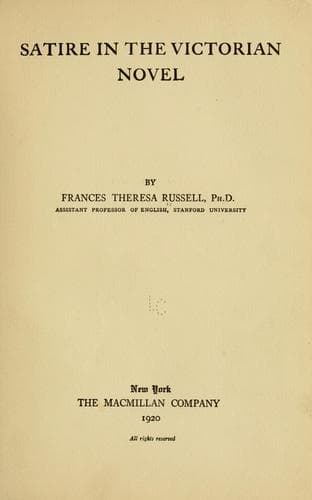
Satire in the Victorian novelRussell, Frances Theresa
History
Satire in the Victorian novel
Russell, Frances Theresa
English fiction -- 19th century -- History and criticism; Satire, English -- History and criticism; Thesis (Ph. D.)
A lively enthusiasm for showing up the ingenuous sentimentalist or
the crafty hypocrite may or may not argue a freedom on the exposer’s
part from these or other modes of hiding or distorting the truth; or
a disinterested love for truth itself. It does go without saying that
real respect and admiration for honesty and sincerity is a fundamental
human trait, as witness the glowing encomiums bestowed on those
guileless virtues, and it might follow that our unmoral impulses are
half consciously focussed through a moral function. We must have a sin
offering; and deceit is in the most eligible. Thus the satirist may,
deliberately or unthinkingly, read deception into his disapproved,
in order to have an excuse for laughter, just as he may read vice
and folly into his disliked, in order to condemn. Nevertheless it
is possible to enjoy the process of unmasking without making it a
corollary that masking is wrong and therefore deserving of exposure.
Some observers are more impressed with the resemblances among the
members of the great human family, and some more sensitive to the
differences. When a consciousness of this variance is dissolved in a
humorous solution, it precipitates a satire. The satirist is not always
a victorious Saint George, and the satirized a downed and disgraced
Dragon. Still, if the Saint could be secularized to the extent of a
mocking light in his eye, and a taunting finger pointing at a removed
disguise under which the Dragon had been masquerading, we might take
the picture as a symbol of an ideal relationship between them, both
ethically and artistically.
For there is an ideal in this as in all things that have variation and
flexibility; and, as in them all, the question of quality is the most
important one. Without some sort of criterion we can form no judgments
as to value. The points we have been considering,--what satire is made
of, why and how made, against what directed, and in what effective, all
lead to the final one,--what is the highest type?
The trend of testimony seems to converge on three requirements for
that satire which would disarm criticism while indulging in it: purity
of purpose, kindliness of temper, and discrimination as to objects of
ridicule.
The first is not to be confused with the reformatory motive.
It means simply freedom from the very affectation censured in
others. What it rules out is not so much the railing to gratify
one’s spleen, as the pose of altruism while doing it; the grieved
this-hurts-me-more-than-it-does-you attitude so particularly annoying
to the castigated. It also discounts the selfish vanity which courts
applause for wit, regardless of the means by which it is won.
On this point Horace[53] again heads the list. He denies the
accusation that the satirist is spiteful, and continues:
“_Liberius si_
_Dixero quid, si forte jocosius, hoc mihi juris_
_Cum venia dabis._”
Public-domain text, read in full here on John Shaqi.
Reviews
Reviews
No reviews yet
Be the first to share your thoughts on this work.
Join the Discussion
Join the discussion
Sign in to leave a comment or review.
Sign InorCreate an account