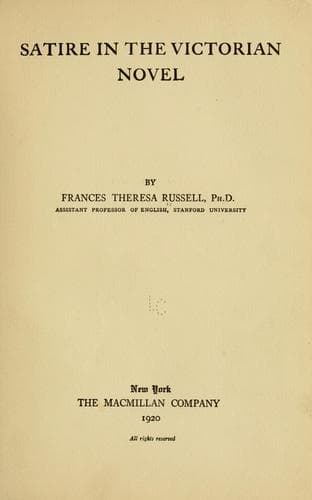
Satire in the Victorian novelRussell, Frances Theresa
History
Satire in the Victorian novel
Russell, Frances Theresa
English fiction -- 19th century -- History and criticism; Satire, English -- History and criticism; Thesis (Ph. D.)
From the nature of English satire up to the eighteenth century, we do
not expect, nor do we find, much interest in this phase of it. Then
comes Young,[54] reviving the Horatian caution:
“Who, for the poor renown of being smart,
Would leave a sting within a brother’s heart?”
And Cowper[55] completes the portrait:
“Unless a love of virtue light the flame,
Satire is, more than those he brands, to blame;
He hides behind a magisterial air
His own offenses, and strips others bare;
Affects, indeed, a most humane concern,
That men, if gently tutor’d, will not learn;
That mulish folly, not to be reclaimed
By softer methods, must be made ashamed;”
De Quincey[56] uses Pope as a horrible example of this failing,
contrasting him with the indignant Juvenal:
“Pope, having no such internal principle of wrath boiling in his
breast, * * * was unavoidably a hypocrite of the first magnitude
when he affected (or sometimes really conceited himself) to be
in a dreadful passion with offenders as a body. It provokes
fits of laughter * * * to watch him in the process of brewing
the storm that spontaneously will not come; whistling, like a
mariner, for a wind to fill his satiric sails; and pumping up
into his face hideous grimaces in order to appear convulsed with
histrionic rage. * * * As it is, the short puffs of anger, the
uneasy snorts of fury in Pope’s satires, give one painfully the
feeling of a locomotive-engine with unsound lungs.”
Whether these strictures are just or not, the principle back of them is
sound; and more pithily summed up by Landor’s[57] “Nobody but an honest
man has a right to scoff at anything.”
Browning[58] carries the idea a step farther, and sounds a warning to
dwellers in glass houses:
“Have you essayed attacking ignorance,
Convicting folly, by their opposites,
Knowledge and wisdom? Not by yours for ours,
Fresh ignorance and folly, new for old,
Greater for less, your crime for our mistake!”
The demand for kindliness of temper may seem paradoxical, but for
that very reason it is the more insistent. Being under suspicion of
unkindness, vindictive spite, retaliation, satire must either admit the
charge or prove the contrary, for the real paradox lies in the highest
moral claim being made for the literary _genre_ of the greatest
immoral possibilities.
However, until the modern humanitarian cult came in, it seemed content
to admit the charge. After Horace, with a few isolated exceptions, as
Swift[59] and Cowper,[60] satire seemed rather to cherish malice and
glory in rudeness, often mistaking peevish scolding for noble scorn.
Its keynote was “A flash of that satiric rage,” or, according to Hall,
“The Satire should be like the porcupine,
That shoots sharp quills out in each angry line.”
Byron was the last example of both the professional, concentrated form
and the truculent mood. Tennyson[61] voices the new spirit of his
century:
Public-domain text, read in full here on John Shaqi.
Reviews
Reviews
No reviews yet
Be the first to share your thoughts on this work.
Join the Discussion
Join the discussion
Sign in to leave a comment or review.
Sign InorCreate an account